Saturday, July 9, 2022

The Back of Our Minds

It took a little longer than we'd hoped, but our electrical issues were finally resolved on Tuesday morning (July 5) and we were able to get a couple of hours of cruising in after departing Maastricht in the early afternoon.

A small lock off the Juliana Canal to access our overnight port
of choice wasn't working, so we ended up tucking into a side channel
with concrete quays and bollards designed for commercial barges.
No one seemed to be monitoring the moorings and no one made us leave. 

Last year I expressed that I felt a bit of culture shock when entering the Netherlands after months in France and Belgium. Well, consider us "culture-shocked" again after our move from the Netherlands into Belgium. It continues to astonish us how significantly things can change within just a few kilometers. Disappearance of bike culture--check. Disappearance of English-speaking lock-keepers--check. Loss of ability to get a restaurant dinner at 5 or 5:30 p.m.--mostly check. Disappearance of pristine small towns--mostly check (the Belgian small towns we've seen are, shall we say, more eclectic in their layout and architecture.) Disappearance of a mostly flat landscape--check.

After passing through the Lanaye Lock we entered the Albert Canal
in Belgium. It was busy with commercial barges, and somehow we
often managed to concurrently meet, and be overtaken by, commercials.

A short 2-hour cruise on Wednesday brought us to Liege, the 3rd largest city in Belgium. Last year, in our anxiousness to reach Maasbracht, we bypassed Liege, but felt it was worth at least a short stop this year. Liege has long been an industrial and commercial hub, so the outskirts of town have a somewhat "gritty" aspect, but the old city center has retained both charm and history. However, it is also a city very much of the present.

Among the new:

The Liege-Guillemins railway station is a confection of
steel and glass

Streets everywhere in the old part of town were a construction
zone, making cycling even more difficult than normal. It's
all part of a light rail/tram project

Among the old:

The 12th century baptismal font found in Saint Bartholomew's
Collegiate Church, a masterpiece of the goldsmithing craft,
and often said to be one of the seven wonders of Belgium

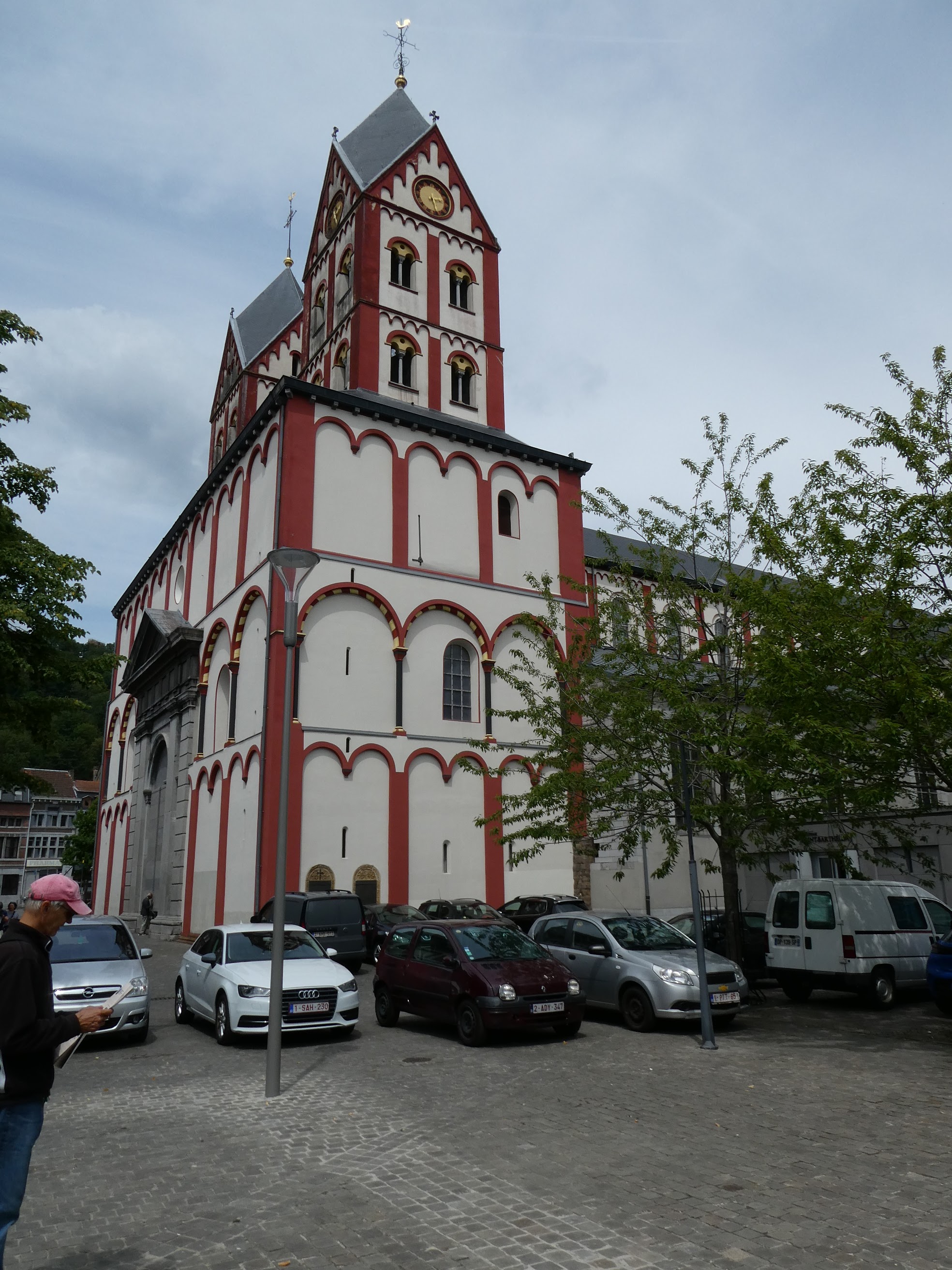
Saint Bartholomew's Collegiate Church, a Romanesque
church originating in the 11th and 12th centuries. 

And a fun bit of the "old" are the Bueren Stairs (Montagne de Bueren), built in the late 19th century to directly link the barracks at the fortifications above the city to the lower parts of the city. 374 steps from bottom to top, it's outdoor exercise extraordinaire and was a touristic challenge that we couldn't refuse.

374 steps up a relatively steep incline in groupings
of 9-10 steps, separated by small landings

"Thank you for visiting without screaming" reminds everyone that
people live in homes adjoining the stairway, and that it is a 
designated quiet zone. I doubt most people have enough breath
left to scream while climbing

374 steps up and the prospect of the same going down
wasn't enough. We added another 60 up (and down) to
get to a war memorial to Belgians executed by Germans
in the citadel during WWI and WWII. (Birds-eye view of Liège at 
the top of the photo)

Some remains of the Liege citadel

What goes up must come down. As Lon begins the 374 steps to return to the
 lower town center, I suspect he was wondering how he let me talk him
into the climb 

Our mooring spot in Liege was on a quay at the point of
an island in the Meuse, in view of river traffic, but
out of the wash

As we moved south of Liege on Thursday and Friday, the industrial aspects of the river were gradually replaced with more natural scenery.

One of the "Ghosts of Industry Past." This was not the only huge
complex that was abandoned. It was actively being torn down

We whistled past this boat graveyard--it's actually labelled on
the boating charts as a "bateaux cimitiere" (boat cemetery)

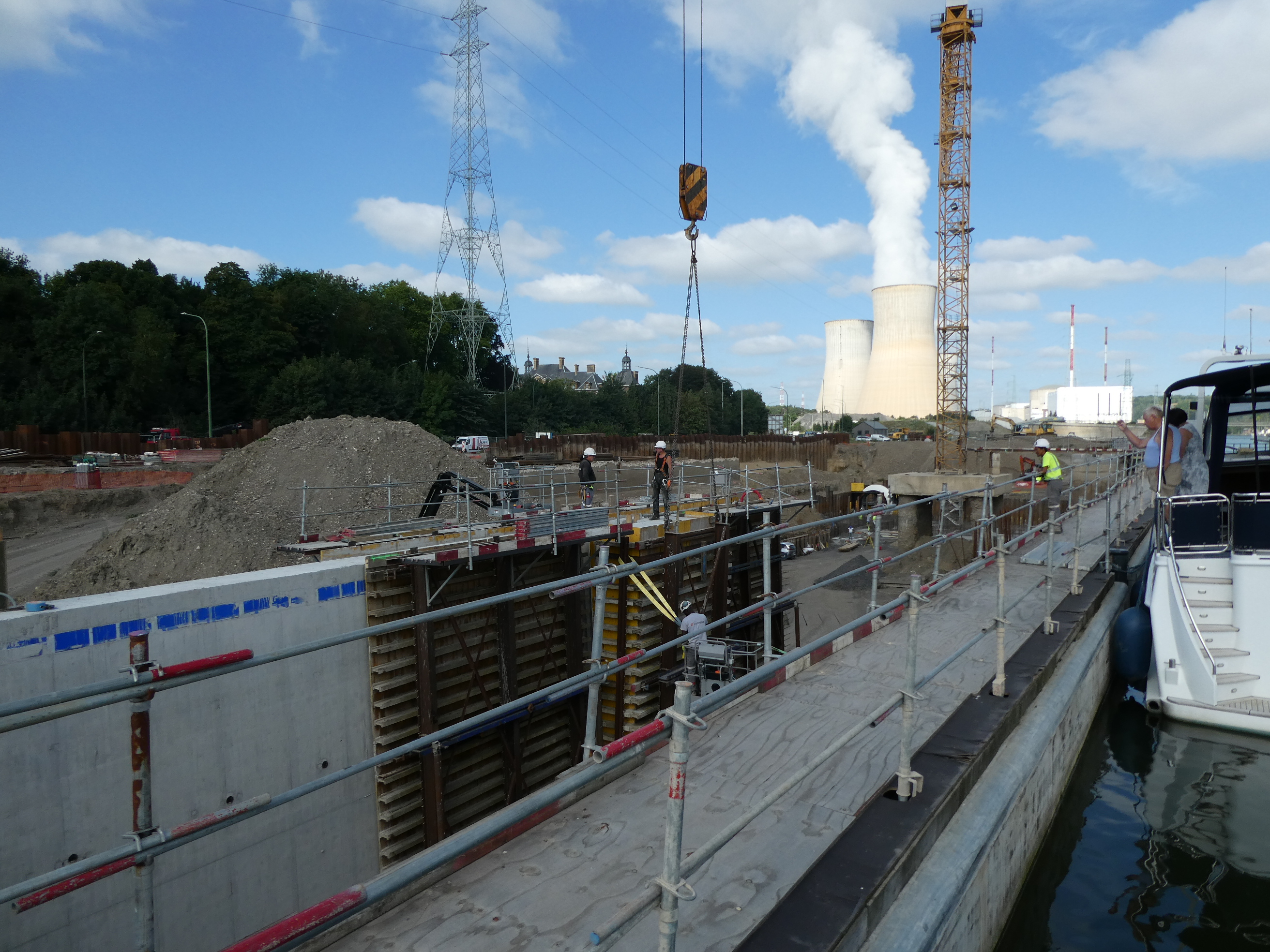
A huge lock reconstruction project was underway at
Ampsin-Neuville

The Chateau de Chokier has a commanding presence over the
Meuse. This is an 18th century rebuild of an earlier medieval 
fortress (its circular tower on the backside is a remnant of
the Middle Ages.) The fortress chateau was one of the strongholds
of Liege in the Middle Ages, and can boast of a "Napoleon was
here" moment in 1811. An electrical fire in 2017 badly damaged one wing

Thursday, July 7, was our wedding anniversary. That evening we were moored just outside the small town of Amay. The weather had been grey and cool all day, with intermittent mist. We went on a brief stroll through town in the afternoon and couldn't generate the enthusiasm to brave the elements for a return trip in the evening for dinner at one of the local restaurants. The honeymoon is, indeed, over. It was nice to stay in and promise ourselves that we would have that anniversary dinner later.

We arrived on Friday at the marina in Beez, just a few kilometers shy of the city of Namur. It's peaceful and quiet here, the port captain speaks English pretty well, and we were able to cycle into Namur yesterday for a brief trip down memory lane (we'd stayed in Namur last year) and that deferred anniversary meal.

The confluence of the Meuse (to the left) and Sambre (to the right) rivers in Namur. The glass
building in the center contains a restaurant where we had a relaxing early dinner. The Namur
Citadel is on the hill, but difficult to see in this photo

Dinner was casual, but the food was good and the setting wonderful

So, four good cruising days and a wonderful dinner. Life is good . . . and then "the other shoe dropped." 

Something we always have to be aware of with our cruise planning are those issues and concerns that occupy "the back of our minds." One of those issues for some weeks now has been concern about the dry weather that France has been experiencing since the winter. Dry weather spells potential problems for the canals in the form of weeds and low water, which can lead to canal closures. In June, France began to implement drought mitigation measures on some of the canals that we planned to use on our way to our winter mooring site in Toul, France. Our thinking was that if we kept up a steady--but not killer--pace in July we would arrive in Toul before the worst of the summer heat and possible August canal closures. We were, therefore, rather surprised (and dismayed) to read an advisory last evening from the VNF (the French waterways authority) announcing the closure of navigation beginning July 13 on a section in the southernmost part of the Canal de la Meuse. The reason is "lack of water resources", and if the current long-range weather forecasts are accurate, there isn't much hope for a reprieve in the near future. The canal closure blocks the route we were intending to take to Toul.

We had originally intended to continue our cruise down the Meuse today, but this is a significant upheaval of our plans and we have stayed in Beez one more day to give us time to consider our various options and do a little research. At the moment, it's likely we will turn onto the Sambre River when we get to Namur and head toward the southwest. Options from that point include an attempt to get to Toul by an alternate route, or a decision to stay more westerly and to locate an alternate winter mooring. It's all relatively short-term decision making at this point. 

But life is still good . . . . 

Monday, July 4, 2022

Getting Underway

Our final few days in Maasbracht last week were busy with cleaning, shopping, finalizing the bill with Tinnemans, a few short bike rides in the area, visits to favorite restaurants, and all of the other things that needed doing before we could cast off on Friday, July 1, to start south.

For these few days in Maasbracht we were moored in the harbor for transient boats

Much as we appreciated the mooring spot that Tinnemans provided when work was being done,
we have to admit that the happy hour view of the Juliana Canal was better from our mooring
spot in the harbor

After some storms passed through on Thursday evening, we were left with a breezy, cool morning to start our return to France.

Commercial barge--and pleasure boat--traffic was pretty constant during our cruise on the 
Juliana Canal

We rode up the 2nd lock of the day with 5 other pleasure
boats. It was the most turbulent experience we've had
in a large lock. We were large enough and far enough back in
 the lock so that we were not affected too much,
 but the smaller boats were getting moved around pretty well

We're backtracking on the route that we followed last year on our way to Maasbracht, which means that our first stop has been the city of Maastricht. We liked Maastricht a lot when we were here last August (and again, briefly, with cousin Frank in May) and are glad to be here again.

No old, historic port for us this year. We decided to take advantage of the free moorings along a quay that stretches between two bridges in the Maas. Mooring here can be in high demand during the summer, so another boat rafted to us when the wall space ran out

Lon on the bridge abutment that overlooks the mooring quay. The oldest part of Maastricht is
to the right. Lots of steps up and down, so the bikes are staying on the boat

We are able to see a constant "boat parade" from where we sit,
as the main channel of the Maas is just on the other side of the wall--
barges, river cruise ships, tourist day cruises, and all manner of
pleasure boats

We'd explored the center of town pretty thoroughly last August, so for a different experience we walked to St. Pietersburg Hill on the south side of Maastricht. There we toured old Fort St. Pieter and the nearby Northern Caves.

The French captured Maastricht in 1673 (during the Franco-Dutch War) after a siege directed by the French military engineer Vauban took advantage of the elevation provided by St. Pietersburg Hill (Fun Fact: The French Musketeer d'Artagnan, made famous by "Three Musketeers" writer Alexandre Dumas, participated in this campaign and was killed by a musket ball on June 25, 1673). The city was returned to the Dutch a few years later, and around 1700 a fort was constructed on the hill to provide better defenses and keep the advantage of height from any subsequent invaders. 

The lower level was constructed around 1700, the upper level
in the 1800's. The fort was never taken, but then again, it only 
participated in one battle--in 1793, with the French again--and the
Dutch won that engagement

The "strategic view" of Maastricht from the top of Fort St. Pieter

While on the hill we also toured a portion of what are called the "caves of Maasbracht", but which are really a collection of limestone quarries that originated in the 13th century. Over the centuries, huge limestone blocks were cut from the ground to be used in multiple construction projects. When the industry no longer made economic sense, portions of the cave complex were turned over to tourism. During WWII the caves provided sanctuary and/or an escape route to Belgium for several thousand citizens. In that same period a "vault" was also constructed in order to store many valuable Dutch artworks, including Rembrandt's "The Night Watch."

A map that shows the tunnel system that existed in the "caves". The mining created thousands of tunnels and chambers; we saw just a small portion of the tunnels comprising the section in the upper right of the photo

As part of the "rebranding" of the caves as a tourist attraction, 
artists were allowed to create charcoal drawings. There is nothing
ancient about this Cleopatra--she is purely a 20th century creation

We had originally planned to continue cruising today and enter Belgium, but the boat had other ideas. Some electrical issues that we thought had been resolved have reappeared, so we are currently awaiting a "house call" from the electrician who worked on C.A.R.I.B. III in Maasbracht. Fingers crossed that it can be diagnosed and fixed quickly. 

Besides just a general wish to be moving, I have another reason for wanting to cross the border. It appears Dutch bees have taken an interest in me, as I have been stung twice in the last week.  It's not as though I have been aware of doing things to either attract or anger bees, but it seems not to matter. I'm getting a little tired of itchy, irritated skin, and am hoping that Belgian bees will ignore me. 


Monday, June 27, 2022

When Technology Fails

The Dutch locks on the Maas River and on the canals we've traveled the past few days have been technological marvels. Most of the locks (and lift bridges) are no longer operated with on-site lock and bridge tenders, but are controlled remotely from centralized locations and are thus highly dependent upon a myriad of cameras and other sensory devices at each lock and lift bridge. We have been pleased with how well and efficiently the locks and bridges have worked for us during our 2-week cruise. Until yesterday.

We left the city of Den Bosch on Saturday morning via the Zuid-Willemsvaart and spent the night at a mooring in the village of Beek en Donk. Our plan on Sunday was to cruise for four hours and stop for the day. One-and-a-half hours into the cruise, at 10:30 a.m., we were halted at Helmond Lock.

The dreaded vertical "double red" signifies that a lock is not functioning

We were not the only boat to be stopped and were able to get the "scoop" on what the problem was from a Dutch gentleman on the boat in front of us. The Helmond Lock is operated from a center in the city of Tilburg, about 35 miles from Helmond. Apparently, the cameras at the lock had gone black, and without cameras it was not possible to get boats safely through the lock. The Dutch water services did not have sufficient staff to send a lock tender to Helmond for on-site operation. The fact that it was Sunday probably complicated matters as well. Tilburg did not have an appropriate technician on-site at the control center and had to send for one from the city of Utrecht (about 50 miles from Tilburg). So, we tried to relax, had a leisurely lunch, and continued to wait some more. The lock was still inoperative at 3:00 p.m., at which time we decided that, even if the lock were to be fixed, it was too late in the day for us to continue. Some locks stop operating at 5 p.m. on Sundays and mooring spots are somewhat scarce in that section of the waterway. We decided to spend the night moored to the lock quay and take an hour or two to "escape" the boat and get an impression of the city of Helmond.

Helmond had a fair amount of industry, and the central part of town was mostly newer construction with no cohesive "feel" to it. It did have two really interesting features, however, a castle and "cube houses."

These "cube houses" were designed by architect Piet Blom in the early 1970's. They are supposed
to be evocative of trees. They initially formed an architectural whole with a theater that was
destroyed by fire in 2011. Subsequent, and more famous, versions of Blom cube houses are in Rotterdam. The angles of the walls and windows were somewhat disorienting to look at--and no doubt the houses require a good deal of creative thinking with respect to furniture and window coverings

Helmond Castle is the largest moated castle in the Netherlands. Construction of the castle 
started around 1325. It passed into city hands in the 1920's and was used for a time as a town
hall. The castle is currently the location of Museum Helmond and also serves as a wedding venue

When we got back to the boat after our brief excursion into Helmond we found that the lock was back in operation. It remained that way overnight and worked perfectly when we went through this morning.

Prior to the lock misadventure we'd had several interesting days. As mentioned in the previous posting, our last cruising day on the Maas River was Wednesday, June 22.

Playing "dodge the ferry." There aren't a lot of bridges over the Maas, so ferries were a 
common sight along our entire Maas route

The captain of this commercial barge greeted us via horn, no doubt because we, like he,
had a Polish boat registration

While it was mostly sedate cruising, we did have a brief bit of excitement just before we turned onto the Maxima Canal.

Two military helicopters decided to do a "gun run" at low altitude on the Maas, and passed
right by our boat

We spent Wednesday (June 22) through Saturday morning (June 25) in nearly-unpronounceable s'-Hertogenbosch, a lovely old city (dating to the 10th century) of about 150,000. The name is a contraction of archaic Dutch des Hertogen bosch, "the forest of the Duke." It is colloquially known as Den Bosch--much easier for us to say. The Duke to which the name refers was the town's founder, Henry I of Brabant. 

Den Bosch was built in a swampy area between two rivers. Its first walled fortifications were replaced in the 14th century by a second set of walls, which both increased the size of the town and enclosed the branches of the rivers within the city. Most Dutch towns demolished their medieval walls to facilitate growth, and Den Bosch could have done the same after an act on fortifications was passed in the 1870's.  However, the walls were preserved then, and still exist today, because they also served as a defense against flooding.

Outside a portion of the Den Bosch 14th century fortifications

One of Den Bosch's "claims to fame" is that it was the hometown of Jheronimus Bosch, a painter of the late Middle Ages (1450-1516). He came from a family of painters, although he became the most famous of them. Not many of his works still exist, but those that do are full of references to morality, church, sexuality, and conscience. It is also said that the people of the time found a great deal of humor in his work. One cannot deny that he had an extremely "active" (and may I say, strange) imagination (Google "The Garden of Earthly Delights" for a glimpse of Bosch.) Interestingly, not a single one of his works is in the city of Den Bosch today. 

A former Catholic church now houses the Jheronimus
Bosch Art Center. Sculptures in the plaza out front
represent interpretations of images from Bosch's works

Mostly we just enjoyed walking around town to enjoy the sights. Unlike many of the towns and cities we've visited on our current cruise, Den Bosch did not suffer destruction in WWII, so many of its buildings of historical interest still exist. We also took a small boat canal cruise on the Binnendieze, the term for the branches of the rivers contained in the city walls that served as a city transport route starting in the 15th century. Of the original 12 kilometers of waterways about 3.5 km still exist.

Shopping street in central Den Bosch

Saint John's Cathedral is celebrating its 800th anniversary this year. Most
of the construction is not that old, but the church is considered to be
the height of Dutch Gothic

The stone façade of the late 13th century Saint Anthony's
Chapel, now incorporated into a modern office building 

The Moriaan is known as the oldest brick house in Den Bosch. 
The oldest preserved parts date to the 13th century, although 
the current appearance is mostly 14th century. The local tourist
office currently occupies the 1st floor 

Getting ready for "Opera on Parade" in the plaza outside Saint John's

The main aisle in the interior of Saint John's. The 
mural work on the ceilings dates to the late
15th or early 16th century
  
Looking forward to our canal cruise in "underground" Den Bosch

Going down to board the boat

A chapel (center) was built over the river. It was once part of a large
monastery dating from the 16th century. There were once so
many churches and monasteries that the town was called
"small Rome"

It's a whole different perspective from the watery basement 
of the city

Bats are provided with dwellings in the shape of a bat.

A modern passageway was cut through the
old 14th century wall to emerge outside the 
borders of the medieval town
 
Friday's weather was a little unsettled, so we located the local multiplex and enjoyed "Elvis."

We liked this theater! Cushy seating like we have in our local
theater in St. Petersburg

Saturday morning we left Den Bosch in what turned out to be a "convoy" of a half dozen pleasure boats, all of whom wanted to catch the 10 a.m. opening of a lift bridge near the junction of the Maxima and Zuid-Willemsvaart Canals. It's quite a contrast between river cruising and canal cruising--the locks on the canal are about half (or less) of the length of some of the Maas locks (which means the commercial boats are generally smaller on the canals); the canals have long, straight stretches with very little of the meandering one finds on the river; and lift bridges are now part of the cruising equation.

Canal cruising: straight lines and the occasional lift bridge

Our stop for the evening was a small quay near Lock 6 in the village of Beek en Donk that allowed for up to 3 days of free mooring. 

A little bit of exploration found us at Croy Castle, on the outskirts
of the village of Aarle-Rixtel. The oldest parts of the castle date
from the mid-15th century. Over the centuries several noble
families inhabited the castle. A restoration in 1990 turned the 
castle into an office building. It has a moat!

Saturday dinner was at a fantastic restaurant just down the canal
from the boat, "Eeterij Uniek." Since most of the restaurants don't
have English menus, part of the experience is the use of Google
Translate to help us with our food and drink selections

The restaurant was definitely "Uniek"

It's now Monday evening and we are nearly back to Maasbracht. Given that our cruise yesterday was so truncated, we put in a longer day and are moored for the evening just upstream of the Panheel lock (just a few km to the north of Maasbracht). We'll be in Maasbracht tomorrow.