Thursday, July 14, 2022

Unbelievable

It's been an eventful few days, to say the least. Our Saturday in Beez was spent pondering the pros and cons of our various cruising options in light of the recent closure of the Canal de la Meuse , and the port captain there gave us a helpful perspective. In the end, we decided that it was safest to take the Sambre route. Decision made, we did a little last-minute exploration of the area around Beez.

The white cross--and the letter "A" formed from
shrubbery-- marks the spot where Belgian King Albert I died
 in 1934 while rock climbing in an area of
cliffs known as "Marche-les-Dames." At the time, conspiracy
theorists postulated that he had been killed elsewhere and his
body planted at the site. In 2016, DNA testing of bloody
leaves that had been taken from the site lent support to the
official version of the king's death

One of our concerns about cruising the Sambre was the amount of commercial barges that we had observed in Namur on Friday entering and leaving the Sambre. It's a narrower river than the Meuse, and we were uncertain about what commercial traffic might mean for us in terms of delays at locks. As it turned out, cruising on a Sunday was probably the best thing we could have done, as it seemed that all of the commercial bargees must have been taking the day off. We had the waterway nearly to ourselves; we saw no commercial traffic and very little pleasure boat traffic.

Turning onto the Sambre River in Namur, we cruised under
the cable cars making their way to and from the Citadel

It's a small world--and a nearly unbelievable coincidence that of
the few boats we saw, we again encountered fellow Americans
 Dave & Becky on Wanderlust. (They were moored next to us when we were at
 Port Royal in Auxonne, and we met them in Void, France
 during 2021's cruise.) It's very strange the way our cruises keep coinciding,
 but like last year, we were headed in opposite directions

We had thought that the landscape between Namur and the next large city "down the road", Charleroi, would be heavily industrial. Although there was some industry noted on this first day, for the most part it was a pleasant and pretty cruise.

We almost stopped for the evening in Floreffe, under the watchful
eye of the former Abbey of Premontres (founded 1121 and rebuilt
in the 17th and 18th centuries), now a seminary. However,
mindful of our Schengen deadline, we moved on a bit further

Our cruise on Monday gave us some of the "grit" that we'd been expecting earlier. The closer we got to the city of Charleroi (literally "King Charles," after the 17th century's Charles II, King of Spain and the Netherlands), an industrial center trying to make its way back after a period of decline, the more "unlovely" landscape we saw. The cruise through Charleroi and its numerous abandoned industrial buildings felt a lot like a portion of our Great Loop cruise in 2014, when the "Cal-Seg" took us through the industrial areas south of Chicago. Very dismal. Getting to the other side of Charleroi and back into more natural surroundings put me in mind of the scene in the Wizard of Oz when Dorothy steps out of black and white Kansas into colorful Oz.

The Charleroi waterfront felt very bleak

Ahhhh . . . back into more restful surroundings

Monday evening found us on a quay with a view of the ruins of  l'Abbye d'Aulnes. Originally founded in the 7th century, the buildings fell victim to destruction by post-Revolutionary French in 1794. We weren't really in a town in the usual sense, but there were several restaurants in the area, and it was humming with people

The Abbey was imposing, even in its decrepit state. Adjacent to the 
ruins was a fancy wedding and events center

We were a curiosity for this group of youngsters 

A short 2-hour cruise on Tuesday brought us to the lovely little town of Thuin. The elevation of the upper town was a good test for our e-bikes. As it turned out, the elevation wasn't a problem, but the cobbles were a killer.

Coming into Thuin. The belfry tower (1640) in the upper town is 
all that remains of the collegiate church that was destroyed in 1811

Here we are in Bird Song Park overlooking the old ramparts
and terraced gardens

An unobstructed view of the "suspended gardens" and ramparts of the medieval town. The terracing was part of the defensive structures

Lon descends a passageway through the city wall
to get to a pathway amidst the terraced gardens

Narrow streets and old buildings of medieval Thuin.

Someone really liked bird decorations--how
very Alfred Hitchcock

After we left Charleroi, the locks on the Sambre shrank to the "Freycinet" gauge that we encounter on many of the French canals. The largest commercial barges that can pass through these locks cannot exceed 38 meters in length. The locks were manually operated, which meant telephoning the locks to request passage (always a joy with my limited grasp of French.) Fortunately, I only had to phone the first lock of the day, and that lock keeper would notify the other locks that we would be needing passage.

Pat assisting the lock keeper at one of the manual Belgian locks

On Wednesday the 13th we passed from Belgium into France, beating our 90-day Schengen area deadline by 4 days. Not that anyone checks at the border, but still. Whew! The French have automated their locks, so we collected a remote-control device from the first lock we went through in France.

Not a "Telecommande for Dummies"--this
baby does it all

It was a rather warm day, and so we were happy to be able to stop shortly after noon in the town of Jeumont, about 3 km beyond the border. It was a great town quay, complete with electricity and water, and all for no cost. We had lunch, were winding down, and then came the knock on the door. So sorry, you can't stay here, there are fireworks this evening in this area. (Bastille Day is the 14th, but some towns have their celebrations early.) Not happy, because there aren't a lot of mooring options in this part of the Sambre. But we had no choice except to start cruising and see what we could find. A town dock in Boussois just 4 km away was totally decrepit and couldn't be used, so 2 hours after we started, we finally ended up at a rather "sketchy" mooring in the town of Maubeuge.

The proverbial "port in a storm", because we wouldn't
have picked this place were we not so hot, tired, and
without other close options  
  
About 90% of the center of Maubeuge was destroyed in WWII, so 
the town lacks many historical buildings. However, it had retained
 extensive fortifications dating back to Vauban in the late 17th century
(and later modifications). They're spread out over a large area and 
would be interesting to explore with more time

The Bastille Day celebrations in Maubeuge included live music in the town square

Our July 14th didn't go quite as planned. We thought that about 45 minutes of cruising would get us to the marina in Hautmont, but we didn't count on the lock that was impassable because it was shut down for the Bastille Day holiday. 

A Bastille Day parade in Hautmont--and the lock we
couldn't use

It was an easy day--a walk to check out the port and the town, relaxation, and dinner on the boat--and then came the knock at the door by local law enforcement. So sorry, you can't stay here, there are fireworks here this evening. Unbelievable--again? It was our very own version of Groundhog Day. Fortunately, we didn't have to move far; we were told we could stay on the wall just prior to the lock gates. And we did have the consolation of a front row seat for what turned out to be rather decent fireworks for a small town. The lock should be working again tomorrow, and we'll be at the marina before we know it.

As it has turned out, our decision to take the "Sambre option" was the correct one. A notice came out from the VNF announcing the closure of a portion of the Canal de la Marne au Rhin Ouest, which means that we now have no alternate way to cruise to Toul and must find a different winter mooring site. We'll be inquiring here in Hautmont, and hope they will be able to solve that particular problem for us. We're going to stay here for a few days anyway to give us time, if needed, to investigate what other marina options might be out there and avoid cruising during a brief heat wave early next week. Hopefully we can get where we need to go before all of the canals are closed!

No rain in sight and 100 degrees is forecast for Tuesday.

Saturday, July 9, 2022

The Back of Our Minds

It took a little longer than we'd hoped, but our electrical issues were finally resolved on Tuesday morning (July 5) and we were able to get a couple of hours of cruising in after departing Maastricht in the early afternoon.

A small lock off the Juliana Canal to access our overnight port
of choice wasn't working, so we ended up tucking into a side channel
with concrete quays and bollards designed for commercial barges.
No one seemed to be monitoring the moorings and no one made us leave. 

Last year I expressed that I felt a bit of culture shock when entering the Netherlands after months in France and Belgium. Well, consider us "culture-shocked" again after our move from the Netherlands into Belgium. It continues to astonish us how significantly things can change within just a few kilometers. Disappearance of bike culture--check. Disappearance of English-speaking lock-keepers--check. Loss of ability to get a restaurant dinner at 5 or 5:30 p.m.--mostly check. Disappearance of pristine small towns--mostly check (the Belgian small towns we've seen are, shall we say, more eclectic in their layout and architecture.) Disappearance of a mostly flat landscape--check.

After passing through the Lanaye Lock we entered the Albert Canal
in Belgium. It was busy with commercial barges, and somehow we
often managed to concurrently meet, and be overtaken by, commercials.

A short 2-hour cruise on Wednesday brought us to Liege, the 3rd largest city in Belgium. Last year, in our anxiousness to reach Maasbracht, we bypassed Liege, but felt it was worth at least a short stop this year. Liege has long been an industrial and commercial hub, so the outskirts of town have a somewhat "gritty" aspect, but the old city center has retained both charm and history. However, it is also a city very much of the present.

Among the new:

The Liege-Guillemins railway station is a confection of
steel and glass

Streets everywhere in the old part of town were a construction
zone, making cycling even more difficult than normal. It's
all part of a light rail/tram project

Among the old:

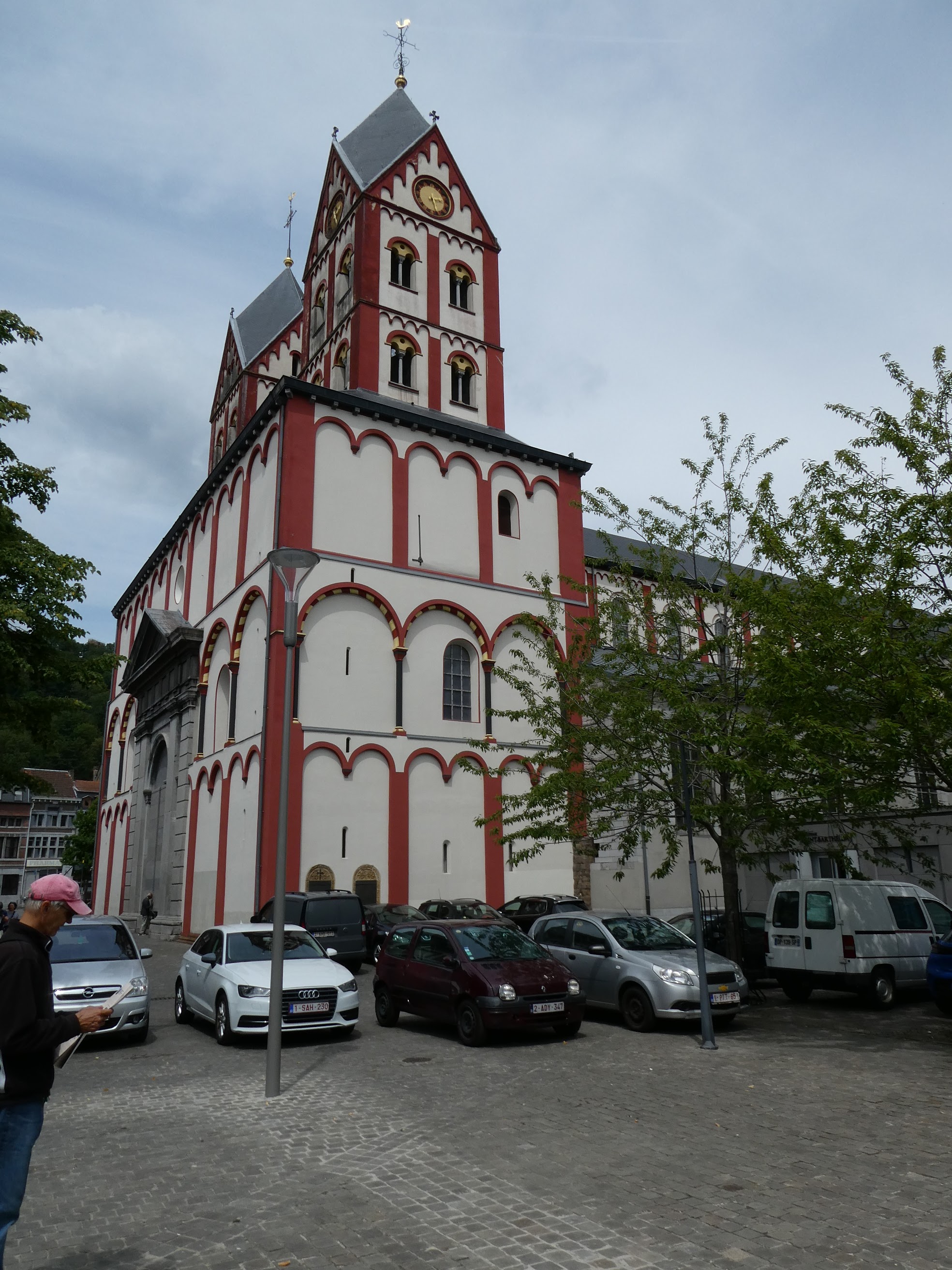
The 12th century baptismal font found in Saint Bartholomew's
Collegiate Church, a masterpiece of the goldsmithing craft,
and often said to be one of the seven wonders of Belgium

Saint Bartholomew's Collegiate Church, a Romanesque
church originating in the 11th and 12th centuries. 

And a fun bit of the "old" are the Bueren Stairs (Montagne de Bueren), built in the late 19th century to directly link the barracks at the fortifications above the city to the lower parts of the city. 374 steps from bottom to top, it's outdoor exercise extraordinaire and was a touristic challenge that we couldn't refuse.

374 steps up a relatively steep incline in groupings
of 9-10 steps, separated by small landings

"Thank you for visiting without screaming" reminds everyone that
people live in homes adjoining the stairway, and that it is a 
designated quiet zone. I doubt most people have enough breath
left to scream while climbing

374 steps up and the prospect of the same going down
wasn't enough. We added another 60 up (and down) to
get to a war memorial to Belgians executed by Germans
in the citadel during WWI and WWII. (Birds-eye view of Liège at 
the top of the photo)

Some remains of the Liege citadel

What goes up must come down. As Lon begins the 374 steps to return to the
 lower town center, I suspect he was wondering how he let me talk him
into the climb 

Our mooring spot in Liege was on a quay at the point of
an island in the Meuse, in view of river traffic, but
out of the wash

As we moved south of Liege on Thursday and Friday, the industrial aspects of the river were gradually replaced with more natural scenery.

One of the "Ghosts of Industry Past." This was not the only huge
complex that was abandoned. It was actively being torn down

We whistled past this boat graveyard--it's actually labelled on
the boating charts as a "bateaux cimitiere" (boat cemetery)

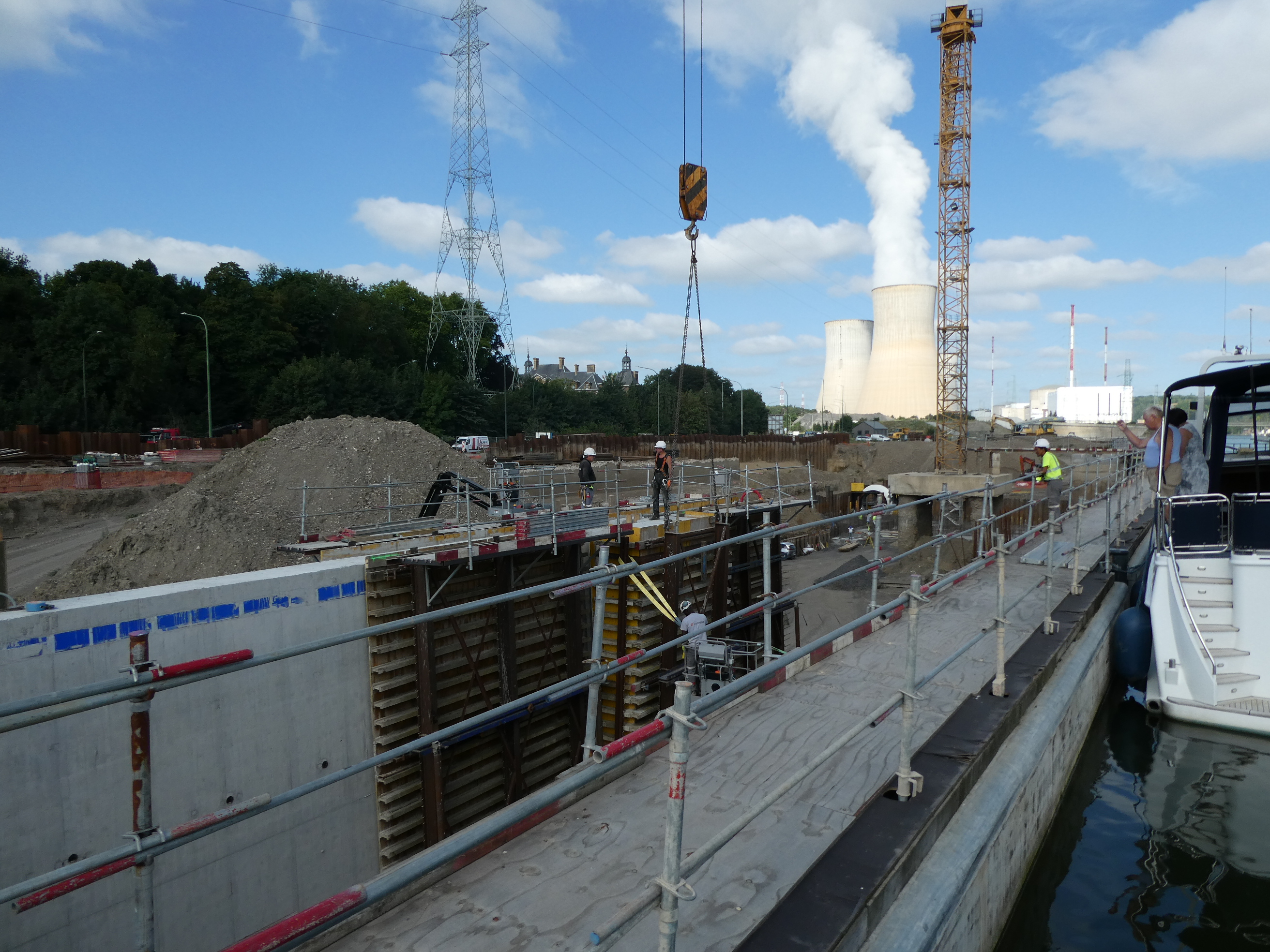
A huge lock reconstruction project was underway at
Ampsin-Neuville

The Chateau de Chokier has a commanding presence over the
Meuse. This is an 18th century rebuild of an earlier medieval 
fortress (its circular tower on the backside is a remnant of
the Middle Ages.) The fortress chateau was one of the strongholds
of Liege in the Middle Ages, and can boast of a "Napoleon was
here" moment in 1811. An electrical fire in 2017 badly damaged one wing

Thursday, July 7, was our wedding anniversary. That evening we were moored just outside the small town of Amay. The weather had been grey and cool all day, with intermittent mist. We went on a brief stroll through town in the afternoon and couldn't generate the enthusiasm to brave the elements for a return trip in the evening for dinner at one of the local restaurants. The honeymoon is, indeed, over. It was nice to stay in and promise ourselves that we would have that anniversary dinner later.

We arrived on Friday at the marina in Beez, just a few kilometers shy of the city of Namur. It's peaceful and quiet here, the port captain speaks English pretty well, and we were able to cycle into Namur yesterday for a brief trip down memory lane (we'd stayed in Namur last year) and that deferred anniversary meal.

The confluence of the Meuse (to the left) and Sambre (to the right) rivers in Namur. The glass
building in the center contains a restaurant where we had a relaxing early dinner. The Namur
Citadel is on the hill, but difficult to see in this photo

Dinner was casual, but the food was good and the setting wonderful

So, four good cruising days and a wonderful dinner. Life is good . . . and then "the other shoe dropped." 

Something we always have to be aware of with our cruise planning are those issues and concerns that occupy "the back of our minds." One of those issues for some weeks now has been concern about the dry weather that France has been experiencing since the winter. Dry weather spells potential problems for the canals in the form of weeds and low water, which can lead to canal closures. In June, France began to implement drought mitigation measures on some of the canals that we planned to use on our way to our winter mooring site in Toul, France. Our thinking was that if we kept up a steady--but not killer--pace in July we would arrive in Toul before the worst of the summer heat and possible August canal closures. We were, therefore, rather surprised (and dismayed) to read an advisory last evening from the VNF (the French waterways authority) announcing the closure of navigation beginning July 13 on a section in the southernmost part of the Canal de la Meuse. The reason is "lack of water resources", and if the current long-range weather forecasts are accurate, there isn't much hope for a reprieve in the near future. The canal closure blocks the route we were intending to take to Toul.

We had originally intended to continue our cruise down the Meuse today, but this is a significant upheaval of our plans and we have stayed in Beez one more day to give us time to consider our various options and do a little research. At the moment, it's likely we will turn onto the Sambre River when we get to Namur and head toward the southwest. Options from that point include an attempt to get to Toul by an alternate route, or a decision to stay more westerly and to locate an alternate winter mooring. It's all relatively short-term decision making at this point. 

But life is still good . . . . 

Monday, July 4, 2022

Getting Underway

Our final few days in Maasbracht last week were busy with cleaning, shopping, finalizing the bill with Tinnemans, a few short bike rides in the area, visits to favorite restaurants, and all of the other things that needed doing before we could cast off on Friday, July 1, to start south.

For these few days in Maasbracht we were moored in the harbor for transient boats

Much as we appreciated the mooring spot that Tinnemans provided when work was being done,
we have to admit that the happy hour view of the Juliana Canal was better from our mooring
spot in the harbor

After some storms passed through on Thursday evening, we were left with a breezy, cool morning to start our return to France.

Commercial barge--and pleasure boat--traffic was pretty constant during our cruise on the 
Juliana Canal

We rode up the 2nd lock of the day with 5 other pleasure
boats. It was the most turbulent experience we've had
in a large lock. We were large enough and far enough back in
 the lock so that we were not affected too much,
 but the smaller boats were getting moved around pretty well

We're backtracking on the route that we followed last year on our way to Maasbracht, which means that our first stop has been the city of Maastricht. We liked Maastricht a lot when we were here last August (and again, briefly, with cousin Frank in May) and are glad to be here again.

No old, historic port for us this year. We decided to take advantage of the free moorings along a quay that stretches between two bridges in the Maas. Mooring here can be in high demand during the summer, so another boat rafted to us when the wall space ran out

Lon on the bridge abutment that overlooks the mooring quay. The oldest part of Maastricht is
to the right. Lots of steps up and down, so the bikes are staying on the boat

We are able to see a constant "boat parade" from where we sit,
as the main channel of the Maas is just on the other side of the wall--
barges, river cruise ships, tourist day cruises, and all manner of
pleasure boats

We'd explored the center of town pretty thoroughly last August, so for a different experience we walked to St. Pietersburg Hill on the south side of Maastricht. There we toured old Fort St. Pieter and the nearby Northern Caves.

The French captured Maastricht in 1673 (during the Franco-Dutch War) after a siege directed by the French military engineer Vauban took advantage of the elevation provided by St. Pietersburg Hill (Fun Fact: The French Musketeer d'Artagnan, made famous by "Three Musketeers" writer Alexandre Dumas, participated in this campaign and was killed by a musket ball on June 25, 1673). The city was returned to the Dutch a few years later, and around 1700 a fort was constructed on the hill to provide better defenses and keep the advantage of height from any subsequent invaders. 

The lower level was constructed around 1700, the upper level
in the 1800's. The fort was never taken, but then again, it only 
participated in one battle--in 1793, with the French again--and the
Dutch won that engagement

The "strategic view" of Maastricht from the top of Fort St. Pieter

While on the hill we also toured a portion of what are called the "caves of Maasbracht", but which are really a collection of limestone quarries that originated in the 13th century. Over the centuries, huge limestone blocks were cut from the ground to be used in multiple construction projects. When the industry no longer made economic sense, portions of the cave complex were turned over to tourism. During WWII the caves provided sanctuary and/or an escape route to Belgium for several thousand citizens. In that same period a "vault" was also constructed in order to store many valuable Dutch artworks, including Rembrandt's "The Night Watch."

A map that shows the tunnel system that existed in the "caves". The mining created thousands of tunnels and chambers; we saw just a small portion of the tunnels comprising the section in the upper right of the photo

As part of the "rebranding" of the caves as a tourist attraction, 
artists were allowed to create charcoal drawings. There is nothing
ancient about this Cleopatra--she is purely a 20th century creation

We had originally planned to continue cruising today and enter Belgium, but the boat had other ideas. Some electrical issues that we thought had been resolved have reappeared, so we are currently awaiting a "house call" from the electrician who worked on C.A.R.I.B. III in Maasbracht. Fingers crossed that it can be diagnosed and fixed quickly. 

Besides just a general wish to be moving, I have another reason for wanting to cross the border. It appears Dutch bees have taken an interest in me, as I have been stung twice in the last week.  It's not as though I have been aware of doing things to either attract or anger bees, but it seems not to matter. I'm getting a little tired of itchy, irritated skin, and am hoping that Belgian bees will ignore me.