Sunday, July 21, 2024

NeversLand

We arrived at the port in Nevers on Saturday, July 6, and stayed until Tuesday, July 16. We felt comfortable parking CARIB there when we left to search out Loire chateaux, and it was an interesting town to explore during the days before and after that side trip.

Nevers is the 5th largest city in Burgundy. Like the city of Tours, it also carries the French label of "City of Art and History." Nevers became a seat of religious power as early as the 5th century, and a center of temporal power under the Count of Nevers in the late 10th century. Ownership of the town passed through different families over the centuries--becoming the seat of a dukedom in the early 17th century--and was fortified during the Middle Ages, as befits a good medieval town.

Nevers as seen from the south side of the Loire River. The cathedral anchors the old town.
To the right, a more modern Nevers is apparent.


We had most of Sunday, July 7, to make our acquaintance with Nevers via a walking tour. It was rather quiet that late Sunday morning, and the town seemed a little dirty, maybe from the Saturday night before. We noticed a fair number of empty storefronts in buildings outside of what we later encountered as the two main shopping streets. Not unusual for what we've seen in many French towns, but it always seems a shame, nonetheless.

A quick stop at the Tourist Office and we were off to follow the painted "blue line" tourist route through the city.

Nevers is the seat of a Bishop, and has had a cathedral for
centuries. Saint-Cyr-Sainte-Julitte Cathedral is unusual in that
it has two choirs, one Romanesque and one Gothic. It was heavily
damaged during an Allied bombing raid in 1944.


The interior of the Gothic choir, looking toward
the barrier blocking access to the Romanesque
part of the cathedral--closed until 2025.
The Bohier Tower of the Cathedral, its
facade from the 15th and 16th centuries.
We were all set to climb it--but it was
closed as part of the renovation.

To the left, the 15th century Palais ducal. Usually open to tourists,
but on this day, it was a polling place for the local French citizens.
To the right, the Italianate-styled 19th century theater.

21st century construction on the shopping street under
the watchful eye of a 15th century clock tower.


A whimsical hat store; a quiet Sunday street.

The Porte du Croux was one of four defensive gates on the city walls during the 14th century,
and protected the pottery district. The square tower currently houses the city's Archeological
Museum. As it was the first Sunday of the month, admission was free!

The Archeological Museum had an eclectic collection of 
memorabilia, for the most part from excavations carried out
in Nevers or its environs. Small, but fascinating.

More ramparts.

Walking through the old town.

The beach in Nevers is sand along the Loire River. It was from here that the fireworks
for Bastille Day were launched.

July 7 was the last day of a week-long street theater
festival. Since this particular production depended on heavy
use of French--and not just visuals--we didn't stick around.
The topic? The sign says "Non-humans also citizens", so . . . 

Because it was Sunday, most of the churches were closed to tourist visits. We also needed a little time to get ready for our Monday departure to the Loire, so it's a good thing we had Saturday afternoon, July 13, to finish what we'd started on the 7th. 

The Jesuit Saint Pierre Church of the early 17th century contained some incredible 
frescos by Italian artists. The ceiling was partially covered because it's badly in need
of restoration. The floor contained large areas of mosaic tiles.

The 11th century St. Etienne Church. Built by the 
Cluny monks, it is one of the best-preserved Romanesque
style churches in France.

The interior of Saint Etienne has a heavy Romanesque style,
with light coming 
in only from relatively small windows. We had
 seen the interior briefly with artificial light the previous Sunday when
 we quickly ducked in while a service was in progress. It felt
 warm and beautiful and much less "forbidding."


An oddity in France--a church in Baroque style. The Saint
Mary Chapel is the only vestige remaining of a convent founded
in the 7th century. The exterior was restored to its original
condition in the year 2000, but the interior is essentially devoid of
ornamentation or furnishings.

Why a family of warthogs is public art in Nevers, I've no idea. But I loved it.

We also stopped by the Saint-Bernadette Sanctuary. The namesake of the sanctuary was Bernadette Soubirou who, as a 14-year-old girl living in the town of Lourdes in 1858, claimed that the Virgin Mary appeared to her in visions. Even non-Catholics like Lon and I have heard of the shrine, famous for healing, that developed in Lourdes as a result. It has been an international pilgrimage site since 1873, and with about 5 million visitors a year, is purportedly the most visited Christian shrine in the world.

Bernadette later became a nun and joined the Sisters of Charity of Nevers at their convent in Nevers. She died in 1879 of a long illness at the young age of 35. In 1909, during the process that led to her sainthood, her body was exhumed and found to be in an incredibly preserved state. Declared "incorrupt"--preserved from decomposition--it was cited as a further miracle in support of her canonization. After reinterment, she was exhumed twice more, in 1919 when sainthood was bestowed, and 1925. After the 3rd exhumation, models were made of her face and hands so that wax casts could be prepared to cover existing skin discolorations. Her body was then placed in a crystal and gold reliquary and displayed in the main church of the Nevers convent, where she remains to this day. Since 1970, the convent has been a pilgrimage center dedicated to Saint Bernadette.

Re-creation of the Lourdes grotto.

A museum is available on site (we didn't go in) and anyone
may enter the church (to the right). It appeared that the group
of people in the photo may have been intending to hold a special
service of some kind.

Fete Nationale (or "Bastille Day" to us) on Sunday, July 14, gave us a chance to "hit the trail" and cycle back to some areas that we'd had to bypass in order to keep to our "schedule" of reaching Nevers with the boat on July 6. Our primary destination of the day was the village of Apremont-sur-Allier. It's touted as a "medieval village" and is listed as "one of the most beautiful villages in France" (which is really an association membership--with certain requirements--and doesn't actually denote a winner of a beauty contest for towns.) 

Apremont was an 18-kilometer bike ride from Nevers, an easy undertaking on a mostly flat, mostly bike trail, route. On the way was a most interesting sight, the Lorrains Circular Lock, which once led into the Allier River as well as to a branch canal off the Canal lateral a la Loire. Constructed in 1835-1841 for carrying sand barges, dropping water levels in the Allier and the changing economics of sand transport put it out of business relatively quickly.

View down the lateral canal toward the entry
to the round canal. It had a very fancy lock house!


A round lock was needed because of the sharp turn required to 
navigate between the two lock exits. Horses were used to tow the 
boats through the turn.


On to clean and pristine Apremont. Flowers everywhere, Parc Floral adjacent (which we didn't pay to enter), and a lovely setting along the Allier River. The village had two restaurants, a creperie at the river and a brassiere more "downtown." Ah, yes, the car park for residents was on one end of town, leaving the main street free of parked cars and keeping the vista of all that "medievalness" plain to see.

Main street Apremont. All medieval, all the time. No cars from this perspective.

The waterfront was lovely. We ordered dessert crepes for an afternoon break. The friendly
 service and beautiful surroundings made up for the fact that they weren't homemade.

I had mixed feelings about Apremont. It certainly had its medieval bona fides: a 13th century church, a grand chateau overlooking the town, and a history as a quarry village going back centuries. Its population peaked at about 600 in 1850; today, it has somewhere around 70 residents. 

Above: the castle has been much modified since its origins in the 11th
century, but that's true of many castles in France.
Below: the village church.

And who can complain about the absence of decay? Me, I guess. As one who absolutely loves walking around old ruins that are the epitome of authentic, the planned nature of the current village doesn't sit well. Today's Apremont is the re-creation of an idealized medieval village, the brainchild of an industrialist who married into the family that owned the chateau. In the period between WWI and WWII, Eugene Scheider bought up most of the houses in the village. Buildings that didn't fit the desired esthetic were torn down. Schneider hired architects to transform what was left into an ideal of "Berry medieval" architecture, adding turrets and half-timbering and mullioned windows and tiled roofs. Many of the shutters are painted the same, bespoke color. 

The front of the church and a "perfect" medieval house.

The Brasserie du Lavoir.

It felt like Disney, perfectly able to fit into Epcot Center's international section as the exhibit for "medieval French village." Pretty, yes, but it left me feeling unsatisfied. Others will no doubt have a different perspective on things.

We were able to watch the holiday fireworks in Nevers from the back of CARIB; the accompanying music was also audible. It was a great spectacle! The following day, I made the trek to the closest grocery store to stock up, and Lon prepped the boat for departure on the 16th. Time to start moving again!

Thursday, July 18, 2024

Castle Hopping Part 2

On Thursday, July 11, it was back to castles. This time we headed 30 minutes east to the town of Amboise, where we were able to explore two chateaux of interest with no extra driving involved.

The Royal Chateau of Amboise perches on a rocky spur high above the Loire.

Town and river below, chateau and its gardens with a bird's eye view above.

For centuries, the fortresses on the site were owned by high-level nobles, but not royalty. This ended in the early 15th century when the Chateau d'Amboise was confiscated for the crown by Charles VII. His successor, Louis XI--in the great tradition of new homeowners everywhere--started renovating and "adding on." Then, in 1470, our next encounter with Charles VIII and Anne of Brittany takes place, with the birth of Charles in the chateau. When Charles married Anne in 1491, he set up court in his childhood home. Under his oversight, building extensions kicked into high gear--and then disaster struck in 1498.

This non-descript hole in the ground is what remains of a
trench that linked two of the existing lodges of the chateau. On
April 7, 1498, Charles and Anne were taking the trench to watch
a game of real tennis (an indoor variation that pre-dates modern
lawn tennis) when he struck his head on a door lintel. Within
a few hours he was dead at the tender age of 28.

The chateau was occupied by successive kings who made further additions. However, during the reign of Henri IV in the mid-17th century, the royal court was moved to Paris and the decline of the property began. In the French Revolution, the chateau was confiscated, suffered a fire, and was systematically demolished. The chateau that remains today is a shadow of its former self.

Upper: Amboise in the 16th Century at the time of Catherine
de Medici. Lower: the chateau as it exists today.

It may not be as grand as it once was, but the Royal Lodge still impresses.

Left: the music room, with 19th century furnishings.
Right: Lon in the Coat of Arms gallery, the former passage for foot soldiers.

The town of Amboise as seen from the ramparts wall.

One aspect of the history of Amboise that attracts attention today is that Leonardo da Vinci spent the last three years of his life in the town when King Francois I became da Vinci's patron in 1516, appointing him "First Painter, Engineer, and Architect to the King." He is purportedly buried on the grounds of the Royal Chateau.

The St. Hubert Chapel, constructed in 1493. Maybe/probably
the burial place of Leonardo da Vinci. 

King Francois I granted da Vinci the privilege of being buried on the chateau grounds, and the original site of his tomb was the St. Florentin collegiate church, which was demolished between 1806 and 1810. In 1863, excavations were undertaken, and a skeleton was found close to a tombstone bearing fragments of da Vinci's name. Eleven years later, the bones were transferred to the St. Hubert Chapel.

The tomb inside the chapel. I wonder if any current
relatives could be tracked down to attempt some DNA
typing as confirmation of identity--but perhaps no
one wants to open that possible can of worms.

Until his death in 1519, da Vinci was allowed to live at our second Amboise chateau of the day, Clos Lucé. Called Chateau du Cloux until the 17th C, the fortified castle was bought by Charles VIII (he was busy in his short reign!) to be a summer house for French kings. When da Vinci arrived in 1516, he came bearing his manuscripts and three paintings, among them, the Mona Lisa. During the three years until his death, he kept busy with various architectural and civic building projects.

The chateau itself is but a small part of what is a true da Vinci museum that includes the chateau; the large, attached park; and several associated buildings. It is privately owned by a family that has had possession since 1854, and the current generation has created an extremely professional product.

View of the chateau, and in the foreground, a life-size model
of one of da Vinci's inventions (the surrounding park was an
outdoor display area for many models of his various inventions.)


The da Vinci bedchamber, site of his death in 1519.

Artwork in the small on-site oratory (chapel) that
Charles VIII had built for Anne of Brittany. During their
time in Amboise, it was a place for her to mourn the 
deaths of her children.

Leonardo da Vinci's drawing workshop (left) and library (right).

The basement had several rooms filled with small models of inventions
proposed by da Vinci. Many of these same items were reproduced in 
life size in the park adjacent to the chateau.

The town of Amboise itself was rather nice. Somewhat "touristy" in the areas closest to the chateaux, but with a good shopping street leading to the Romanesque Collegiate Church of Saint Denis.

Although the Church of Saint Denis has had several alterations over the years, it still
holds on to many of its 12th century Romanesque elements.

Also interesting were the homes built into the limestone cliffs of the town. Throughout the ages in the Loire Valley, and not just in Amboise, the limestone cliffs were a source of building materials for the many chateaux in the region. Caves created by the removal of the limestone quarried for building have been put to a number of uses, including wine storage and residences. One article estimated there could be as many as 45,000 cave homes in the Loire Valley. (This is not a new concept for Lon and me. Our hometown of St. Paul, Minnesota had a number of man-made caves in the sandstone cliffs near the Mississippi River. One of these caves, now known as the "Wabasha Street Caves," was used as a speakeasy in the 1920's, said to have been frequented by gangsters such as John Dillinger.) 

One of the "Troglodyte Cave Homes" in Amboise.

We left Tours at 8 a.m. on Friday, July 12, destination Chenonceau. We'd purchased advance tickets for a 9:15 entry and wanted to be there in plenty of time. Our decision on Monday to delay our visit to Chenonceau paid off--we were the 2nd car into the parking lot and the 2nd couple to enter the castle grounds when it opened at 9 a.m. Ah, bliss! We were able to see most of the interior rooms with little or no other people. Our experience would have been totally different an hour later.

Left: the main entry hallway at Chenonceau--beautiful Renaissance ceiling work and no people.
Right: the crowds we passed on our way out of the chateau an hour later.

The Chateau de Chenonceau was absolutely beautiful. We'd seen the photos with its gallery built across the River Cher, but it was amazing to see it in person.

Looking across Catherine de Medici's garden to the chateau. The current chateau took the place
of a fortified castle and mill in the early 16th century. The Marques Tower at left is what remains of the
medieval castle.

The Chateau of Chenonceau is known as "The Ladies' Chateau" because its history is intertwined with so many ladies of significance. Built by Thomas Bohier, France's Finance Minister (with construction largely overseen by his wife, Katherine Briconnet), it was seized by King Francois I from Bohier's son in 1535 for non-payment of debts. When Henry II ascended to the throne in 1547, he gifted the chateau to his favorite mistress, Diane de Poitiers. It was she who added the initial bridge over the River Cher, as well as spectacular gardens.

But "hell hath no fury like a woman scorned," so when Henry died in 1559 of injuries received in a jousting tournament, his widow, Catherine de Medici, was quick to force Diane de Poitiers out of Chenonceau. Catherine ruled as Regent for her young son from Chenonceau, added galleries to the bridge, and created gardens of her own. 

The galleries: the upper gallery was a magnificent ballroom; the lower gallery now houses
a collection of paintings, tapestries, furniture, and pieces of art. The south door of the lower gallery
provided access to the "left bank" of the Cher River.

Diane de Poitiers' bedroom.

Catherine de Medici's study, with her lovely
view over the Cher River.

If you're a king, you only have to visit once to have a room named after you. Louis XIV visited
in 1650. Years later, he gifted an uncle with the portrait currently hanging on the wall of what is now
known as "Louis XIV's Drawing Room."

The part of the kitchens used for the preparation
of meat.

An amazing Renaissance ceiling in the Bourbon Vendome vestibule.

The last royal presence in Chenonceau was that of Louise of Lorraine, who spent the last years of her life (1589-1601) mourning the death of her husband Henri III. After that, a series of ladies of the nobility or the industrial rich maintained the chateau.

Fun fact: In WWII, the River Cher was a line of demarcation between Occupied France and Free France. This meant that the entrance to the chateau was in the occupied zone, and the south end of the chateau galleries opened onto the free zone. The Resistance used the chateau on numerous occasions to pass people into the free zone.

We quickly worked our way through a few other displays.

Chenonceau in WWI. The galleries were used as
hospital wards and also had an operating theater.

Lon perusing the "drugs" in Catherine de 
Medici's apothecary.

There's nothing like ending a trip on a high note with a beautiful chateau.  The week was what we call a "Goldilocks" kind of trip--not too much, not too little, but just right. We had a pleasant, if uneventful drive back to Nevers, where we planned to spend an additional 3 days. There were a few places in town we hadn't had a chance to see before we left for the chateaux, a bike ride to take on July 14 to a couple of sights in the vicinity (as, due to the holiday, the locks were closed and cruising was out of the question), and another day for stocking up and cruise preparation.

Monday, July 15, 2024

Castle Hopping - Part 1

In all of our many trips to France, neither Lon or I had ever travelled to the Loire River Valley to experience "chateau culture." It would have been a shame had we failed to do so this year, given that we were going to be cruising on the Canal lateral a la Loire.

The Loire River, called "the last wild river in Europe" because it has never been canalized, separates northern France from southern France. In WWII, Occupied France was north of the Loire; "Free" France (Vichy) was south of the Loire. Several centuries earlier, during the Hundred Years' War, the English occupied the territory north of the Loire and the French were to the south. 

Fortress-like castles had been built in the Loire Valley from the 10th century onwards. After the English were gone from France in the late 15th century, the Italian Renaissance influence began to be felt and the Loire Valley became the "upscale neighborhood" for castles that were less warlike and more pleasure palace for French royalty and their noble underlings. UNESCO recognizes an approximately 175-mile-long stretch of the Loire as a culturally important site. The number of castles? I've seen approximations of 300 bandied about, but how many there were--and how many there currently are--is not easy to figure out. 

We arrived in Nevers on Saturday, July 6, and celebrated our 45th wedding anniversary on Sunday, July 7th, with lunch during a walking tour of the town. (More on that later.) Our focus then turned to chateaux.

For flexibility, we rented a car in Nevers on July 8 for the 220+ km drive to the city of Tours, which would be our base until July 12. Lon had quite a workout with the manual transmission on the secondary roads we took--shifting was frequent due to the numerous speed changes necessitated by towns, villages, and traffic circles. We also experienced a fun bit of serendipity. While the Tour de France cyclists were taking July 8 as a rest day in the city of Orleans, we were surprised to find ourselves driving on a portion of the D976 that would be included in the Stage 10 route on July 9. Good timing on our part!

Meeting cyclists doing some kind of pre-race event; bicycle
decoration in one of the villages enroute; campers staking out
their Tour de France viewing spots along pristine asphalt (the
 road got bumpier when we drove out of the race zone.)

The "slow route" took about 3.5 hours of driving, not including stops. When we were about 40 minutes from Tours, we drove through the village of Chenonceau, the site of a chateau we wanted to visit during our trip. We thought it might be a useful break to do the visit at this time--but that thought lasted about 5 seconds. The mid-afternoon crush of people, cars, and tour buses that we saw in the parking lot quickly disabused us of that notion. Suddenly, a first-thing-in-the-morning stop on Friday during our return to Nevers seemed a lot smarter.

Our airbnb apartment in Tours turned out to be just "OK", but it was within walking distance of the old town, and it had a big plus:

According to the airbnb host, Sancy the Siamese cat is the real
owner of the apartment. He was a lovebug, and I would never
turn down the chance for a lap cat.

To avoid driving fatigue and FCOS--French Chateau Overload Syndrome--we set some parameters for choosing the castles we'd visit: (1) drives to chateaux on Tuesday and Thursday, with a rest-from-driving day on Wednesday to be spent walking around Tours; (2) no more than 2 chateau visits per day; and (3) chateaux must be no more than a 30–45-minute drive from our airbnb.

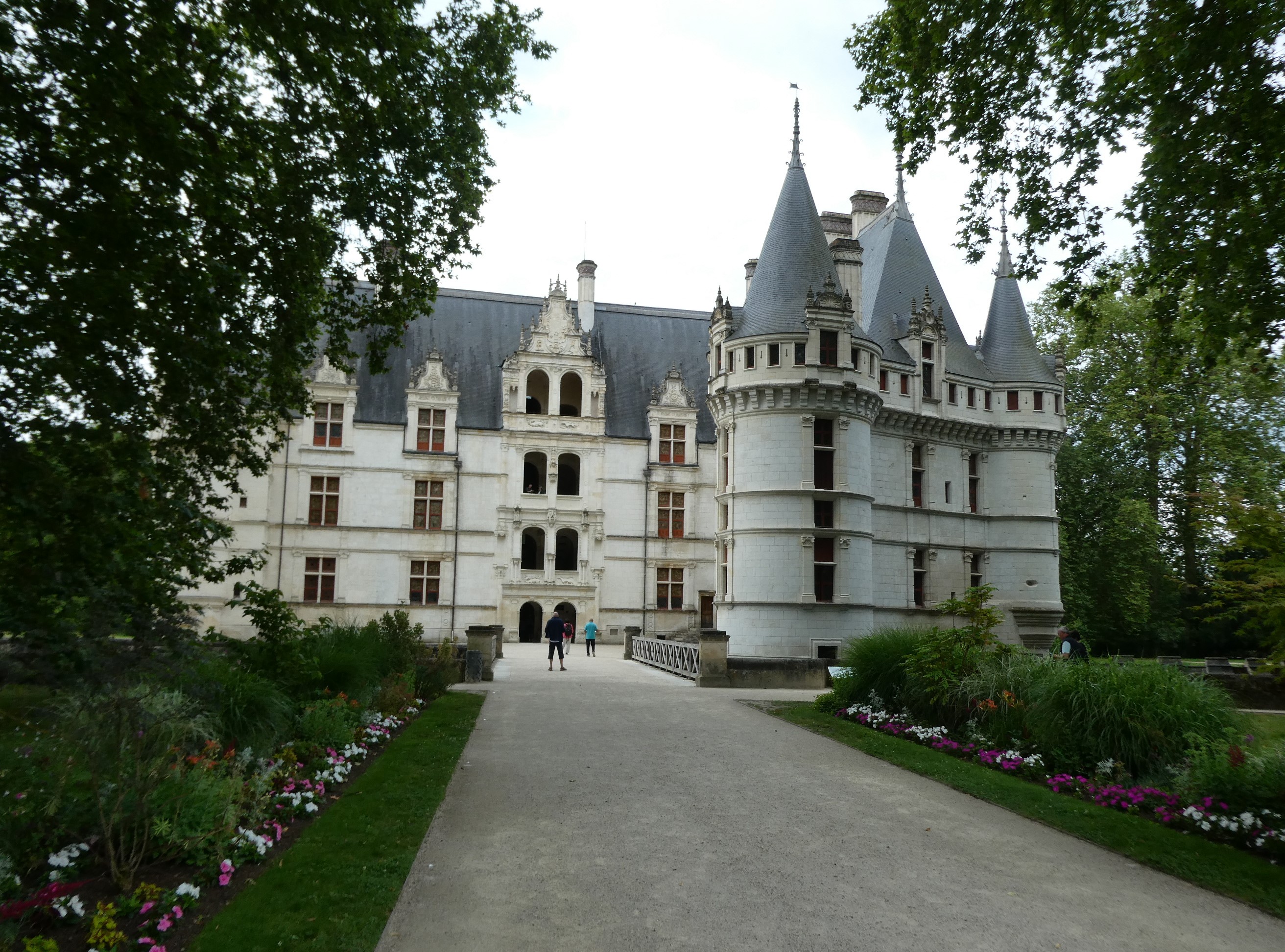
First up on July 9--Chateau d'Azay-le-Rideau, a small, but mighty example of early French Renaissance architecture. Construction began in 1518, and subsequent renovations achieved the current appearance of the chateau by the mid-19th century.

The chateau seems to serenely float on the Indre River. 

Chateau d'Azay-le-Rideau was never a residence of kings, although it did have a "Louis XIII slept here for 2 nights in 1619" moment. It was owned by a series of nobles, including the several generations of Marquis de Biencourt (who invested much in preserving and developing the castle), before passing into the hands of the French government in 1905. 

The rooms on one floor were furnished as they might have been
in the 19th century--but the fireplace is all Renaissance.

The timbers in the attic are those from the original
construction in the early 16th century. The attic
is also a sanctuary for about 50 Greater Mouse-
eared Bats.

The land approach to the chateau, and a hint of the
gardens that surround it.

We switched stylistic gears with our afternoon visit to Chateau Langeais, a mere 20 minutes from Azay-le-Rideau.

Crossing the 19th C. suspension bridge over the Loire
to reach Langeais.

If Chateau d'Azay-le-Rideau was all Renaissance, Chateau Langeais bridges the gap between late Medieval and early Renaissance construction. This was a royal castle, whose construction was ordered by Louis XI and began circa 1463.

On the garden side, we start to see some window frills that are harbingers of the Renaissance.

The city side presents an austere, medieval face, complete
with a drawbridge that must be crossed for entry, and internal
parapets (that can be walked) for defense.

The interior of the castle--as with all of the castles that we visited--was essentially a museum of period artwork, furnishings, and tapestries.

Dining (top) and a bedroom (bottom). Bedrooms were
 used in those days for both sleeping and for greeting guests.

View over the town of Langeais from the castle
parapet. We had time after the castle visit for
a walk through the town: cute, clean, and--of
course--in possession of an old, old church.

It was here that our visits started to become a bit of a "Charles VIII and Anne of Brittany" tour. Encounter number 1: One of Chateau Langeais' claims to fame is that it was the site of their 1491 wedding, a dynastic event preceded by some skullduggery, including an annulment of a proxy marriage. The end result was the closer association of Brittany with France and the prevention of France's encirclement by the Hapsburgs.

The Langeais grounds also contain what remains of the oldest castle keep in France.

The fortified keep was built by Count of Anjou Fulk
Nerra in 994. Only 2 walls remain standing.
It was basically a big box with one floor
 of living space--the original "open floor plan"--and a lower
 floor for storage. The lower photo (the tower "interior")
 shows the medieval approach to scaffolding. Comments
 on some websites lead me to believe that tourists used
 to be able to climb up for a birds-eye view. No longer.

Our "off" day on Wednesday, July 10, didn't involve any driving, but it was anything but "off" overall. We must have walked at least 6 miles in our circuit around the sights of Tours.

No small town, Tours is a full-fledged city with a population of about 140,000. It has been awarded the official French label of "City of Art and History" for its promotion of various aspects of its heritage and architecture. From Roman occupation, to Saint Martin, to a battle that turned back the advance of Islam in western Europe, to capitol of France for 100 years in the Renaissance era, to university town, Tours had a lot for us to see.

Part of the 4th C. Gallo-Roman fortifications. When built, 
it split in two the site where an amphitheater had existed.

Saint-Gatien's Cathedral

Charles VIII and Anne of Brittany Encounter 2: Anne had six
 pregnancies in six years. Only one child outlived infancy, and he died
 of measles at age 3. Four of the six children are entombed in the cathedral.

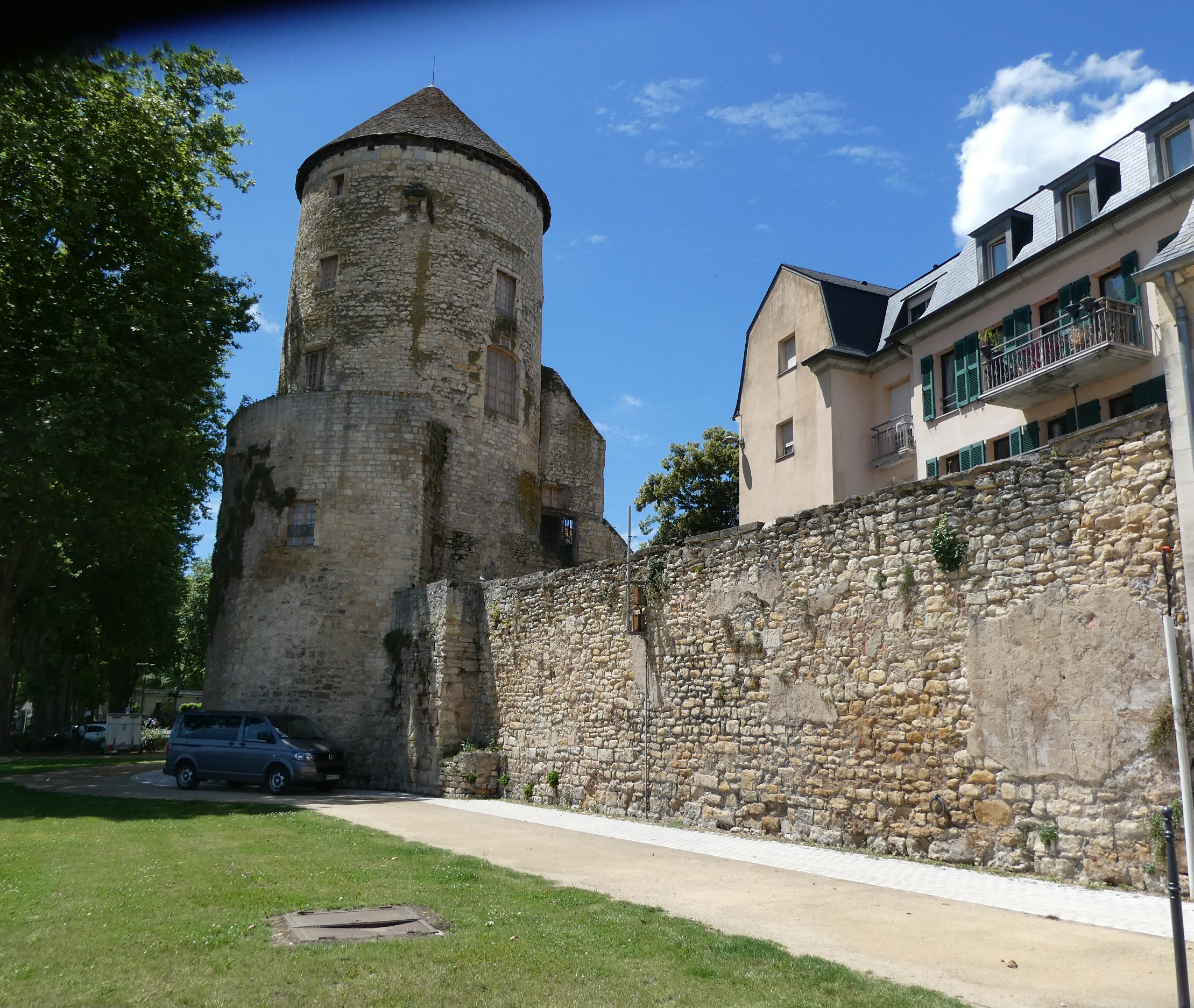
All that remains of the Chateau de Tours is two towers. The
towers were later incorporated into what is now a center
for photographic expositions.

The convention center definitely does not evoke the past.

The beautiful 19th century train station.

This is Fritz. Poor Fritz was part of the Barnum and Bailey Circus
that visited Tours in 1902. He became aggressive (funny what
captivity will do) and was killed. He was "gifted" to the city and
 this "taxidermied" Fritz is the end result. The display isn't meant
to be shocking, but primarily focuses on animal welfare issues.

The old Archbishop's Palace, now a museum of fine arts.

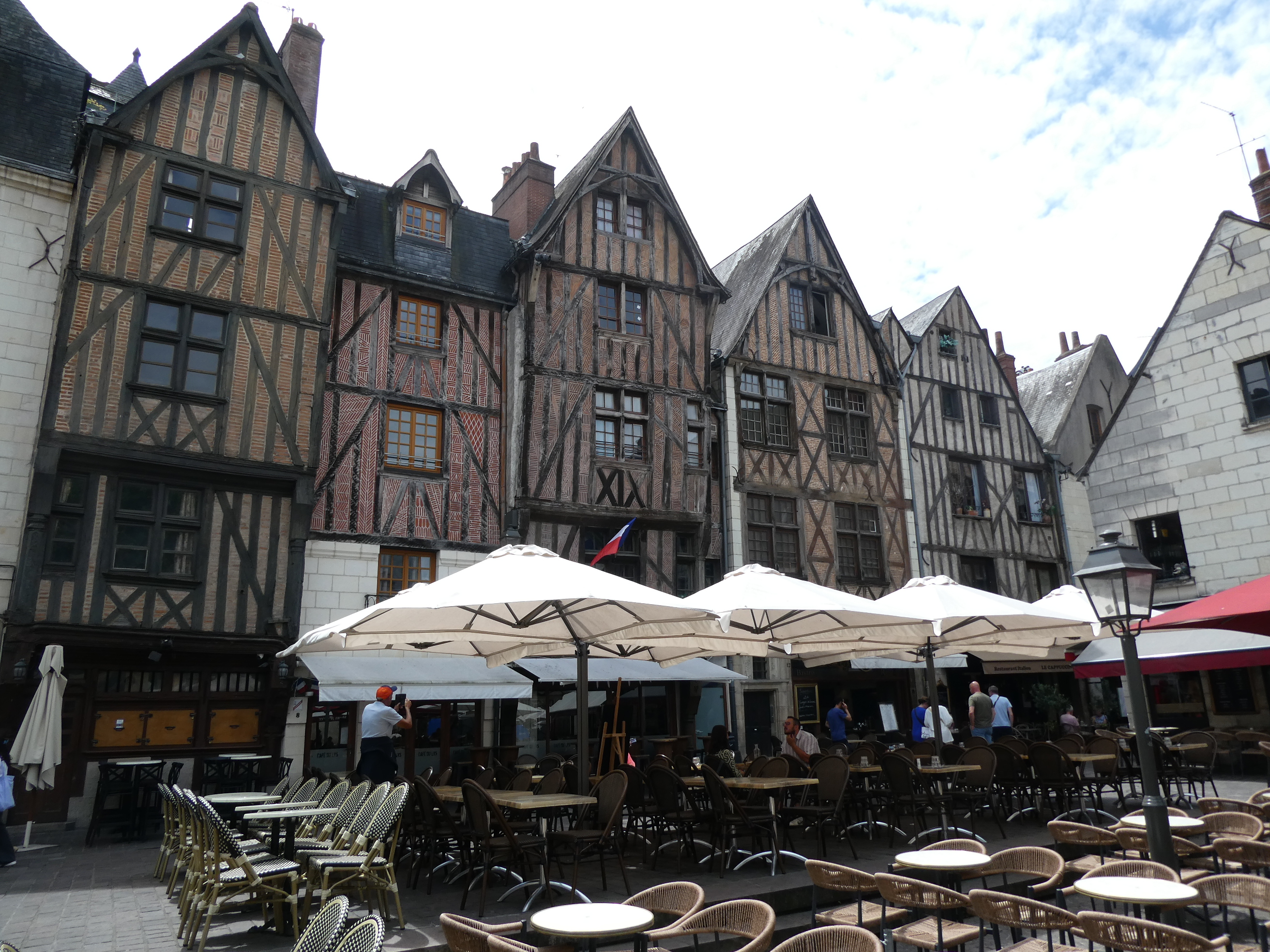
Place Plumereau and its timbered buildings in the old city.

Basilica Saint-Martin, a 19th century tribute to Saint Martin of Tours, a Bishop of Tours in 
the 4th century, and a major patron saint of the Catholic Church.

Saint-Martin's tomb in the crypt of the Basilica. The lower 
portion of the tomb is said to contain a relic of Saint Martin.

Rue Colbert, the main medieval street of Tours.

We had hoped for an evening sound and light show on the facade of the cathedral, a common event during summer in other French towns, but we were disappointed. The city previously put on such a display, but discontinued it during COVID and never started it up again. That's OK, after the extensive walking during the day, a night in the apartment with feet up felt good.