Sunday, July 7, 2019

Happy Anniversary to Us

Forty years ago today we said our "I do's" in the Northwestern College Chapel in Roseville, MN. Memories of that day include a car fuel filter that kept clogging and Shriners everywhere. We still hold a minor grudge against the Shriners for holding their convention in Minneapolis the weekend we got married, thus taking over all of the better hotels. The Radisson Hotel in Plymouth, MN was definitely NOT our first choice for a hotel on our wedding night.

On this July 7 we are in the town of Dannmarie, France. The fuse issues of a week ago were dealt with on July 2 with a car rental and road trip to a boat repair shop--Atelier Fluvial--in St. Jean de Losnes. We bought replacements and spares and were thrilled that the new parts fixed the problems with the bow thruster and the inverter.

We cruised on July 3 to the town of Montbeliard, a town of about 25,000 that is home to the main manufacturing plant of the Peugeot automobile company. Despite its industrial aspects, it has a rather nice old town. Architecturally it is German in flavor, but then, the town only became part of France around the time of the French Revolution. Many of the oldest buildings stem from a city "update" that was accomplished in the early 1600's by Swabian architect Heinrich Schickhardt.

Having dinner with a view of Eglise Saint Martin (1604),
the oldest Lutheran/Protestant church in France. Unlike the 
Catholic churches, the Lutherans don't seem to leave their
buildings open during the day for allowing views of interiors.

Chateau de Monteliard, which was for centuries the seat
of the Dukes of Wurttemberg. The oldest elements of
this iteration of the castle are the bulky circular towers
from the 1400s.
Floral gardens on the chateau grounds

We realized while in Montbeliard that the sight gauge for determining our engine fuel level was not trustworthy and we probably did not have the half tank of fuel indicated. Enormously grateful for not having run out of fuel while cruising, Lon made arrangements for a truck to deliver fuel to us where we were moored. An appointment of "after 10 a.m." on July 5 turned into 1 p.m. before the fuel truck finally arrived. Normally this wouldn't be an issue, except that at Lock 7 upstream of Montbeliard the locks change from automatic (operated by the boater with the VNF-issued apparatus) to manual (each lock operated by a vnf employee). Boaters must call the VNF to make appointments for each boating day--starting point, starting time, and stopping point.  A VNF employee is then assigned to the boater (or groups of boaters if the boats are small enough to fit into the lock together) and drives from lock to lock to set the locks for boat entry and start the lockage sequences.

The very late arrival of the fuel aborted our cruising appointment on the 5th, so we were only able to travel to a mooring short of the switchover point (suffering through waits at 3 broken automatic locks in the process) before stopping for the evening. The next day we made the earliest possible appointment with the VNF and put in a long day of cruising to get to our destination of the port at Dannmarie.

On passing the town of Montreux-Chateau yesterday we entered the "Summit Pound", meaning we had officially passed the high point of the canal. From that point we started to descend as we continued working toward--for us--our  final destination of the city of Mulhouse (where we will turn around and head back the way we came on the Rhone-Rhine). Our first taste of locks going down was a "flight" of 12 locks in the space of about a mile and a half. All-in-all, we went through 21 locks yesterday.

This is what happens when canals are abandoned.
The Canal de la Haute Saone-connected to the
 Rhone-Rhine Canal- was permanently closed in 2018.
 It hasn't taken long for the weeds to take over.
A portion of the flight of locks. It took us two hours to
go through the 12 locks.

This young lady was one of two VNF employees who assisted
us with the "down" locks from Montreux-Chateau to Dannmarie.
She and the young man she was working with bicycled
between the locks.

At rest in the port at Wolfersdorf/Dannmarie

Two war fortifications (foreground and upper left) in the 
vicinity of the marina and next downstream lock. I haven't
yet found any info about which war or which entity created them.

Dannmarie has a national cemetery for dead from the 
Great War. About 400 soldiers are interred here, including
some unknowns. The WWI cemeteries make me sad every time I see them.

We are now in the Alsace administrative department, which
means that the Vosges mountains aren't too far away.

An Alsace stork, possibly just
returned from delivering a baby.
Our destination for this evening's anniversary
dinner. Love the architecture!
Tomorrow will be another long day of cruising. We have an appointment at the next lock--just adjacent to the marina--at 0830. About 20 kilometers, 20+ locks, and an hour-and-a-half lunch break should get us to Mulhouse between 4 and 5 p.m. We're planning to stay at the marina there for about a week and do some day trips by train. We will be joined on July 13 by Lon's Canadian cousin Frank Cedar.


Monday, July 1, 2019

The Heat is On

It. Is. Hot. We spent several days of this record-breaking European heat wave moored in the city of Besançon. We were happy to be plugged into electricity because it made using the air conditioning on the boat easier. The challenge then became one of how to schedule our days so that we could do things but avoid the worst of the dangerous heat. We had originally intended to stay 3 nights, but when we saw the heat forecast for Thursday, June 27, we extended one more day.

We did most of our sightseeing in the mornings, then returned to the boat for the afternoons. For a small city of around 130,000, Besançon has more than its share of historically fascinating sites. Originally a city of a Gallic people, the Sequanes, it became the Gallo-Roman city of Vesontio under Julius Caesar.

Porte Noire (The Black Gate), a Roman triumphal
arch erected around 175 CE during the reign of 
Marcus Aurelius. 

Square Castan. Excavations in 1870 uncovered vestiges of 
Vesontio (amphitheatre, columns, portions of
an aquaduct)

Lon studying Roman mosaics uncovered in Besancon
 and displayed in the local archeology
and fine arts museum.
What would a French city be without its churches?  Besançon has its share, but some fared better than others during the French Revolution.

The former Abbey of St. Paul. Originally constructed
in the 11th century, only some of the 11th C and 15th C
elements remain. It has not been a functioning
church since the late 1700's. During the French Revolution it
was converted into a stable for army horses.
The Cathedrale Saint-Jean was built in the 12th century on foundations that date back to the 3rd century origins of Christianity in Besançon. Elements were added, repaired, and altered at various times up through the 19th century, and it has remained a functioning church.

The Rose of Saint John. This altar from Saint Stephen's cathedral
(no longer in existence) was consecrated by Pope Leon IX in 1050. Eight lobes
(7 days of Creation + Easter) are carved in a circular marble block.
It is the only circular altar that remains in France.
There was also the usual list of worthies who were born or lived in the city. One of the most prominent of Besançon's native sons is poet, novelist, and dramatist Victor Hugo. Outside France, his most famous works are the novels Les Miserables and The Hunchback of Notre-Dame.

Victor Hugo's birthplace
Apropos of nothing in particular, but included just because we liked
the painted black cat in proximity to an attractive green door.
The crowning glory of Besançon's historical heritage is the collection of fortifications built by Sebastien Le Prestre de Vauban, usually just referred to as "Vauban." From 1668 onwards, as the King's Engineer (for Louis XIV, the "Sun King"), he designed and built the first defense system for France's land and maritime borders.  After the first conquest of Besançon by the French in 1668 he designed the plans for the Citadel. After Franche-Comte (including Besançon) finally became part of France in 1674, building on the Citadel and other fortifications continued. In 2008 the Citadel (together with nearby Fort Griffon) was listed as a World Heritage Site by UNESCO (United Nations Educational, Scientific and Cultural Organization).

Panoramic view of the Doubs from the western ramparts of the Citadel. When we approached Besancon we came
upstream from the left. The water to the right in the photo is part of the circuit around the city.
View from the eastern ramparts of the Citadel looking toward
the top of the "boucle". We were moored just above the bridge
second from the bottom. The boat that is visible is waiting to
go through the tunnel cut into the rock under the Citadel.
We visited the Citadel in the morning, so weren't too sweaty yet.
Interior view of the fortifications

Lon approaching the stairway to the eastern
ramparts (and the King's Tower)
The Citadel is home to several museums and a zoo. Perhaps partly in response to the fact that in World War II one hundred resistance fighters were executed in the Citadel by German firing squads, one of the museums (and the one that we visited) is the "Museum of the Resistance and Deportation."

Besides morning sightseeing, other ways to try to "beat the heat" were to find indoor activities to pursue. Our mooring spot was adjacent to the Cite des Arts building, which housed a music conservatory. The nearby neighborhood had many instrumental music stores, and Lon decided to look for a replacement trumpet in one of those stores.

"Leader of the Band" penguin style
The music shop offered instrument sales and repair, and contained 
an eclectic collection of instruments
Lon tries out a few trumpets in the cool
basement of the store. No luck this time.
We spent time one morning in the Museum of Fine Arts and Archeology. It is the oldest public collection in France, established in 1694.  We then spent a lovely late afternoon in the local cinema multiplex watching the English-language version of "Rocket Man", followed by a relaxing dinner in the shade.

"Monkey Barbers of Cats": proof positive that absurdist
animal art didn't start with "dogs playing poker."
Dinner French style. Although only fish and vegetables, it was
almost too pretty to eat. Glad I did though, because it was delicious.
Although it was still hot, we got up early and left Besancon on Friday. Almost immediately we wished we had stayed in bed. When engaging the bow thruster as we set up to approach our first lock of the day we heard a "clunk" and then got no response from the bow thruster switch. Lon opted to continue on to our proposed destination of the day, Deluz, and then take a closer look at the issue. He did a great job of maneuvering into locks and the mooring quay with no thruster. There was a boat repair shop in Deluz, but it being France and Friday, the shop was closing at noon and would not reopen until Monday. So we bicycled to a sporting goods store (10 very warm miles round trip) so that Lon could purchase snorkeling gear and protective footwear for a splash in the canal to look into the bow thruster tunnel for obstructions or damage. The water was relatively clear, and apparently felt refreshing, but I was ready with clean water to rinse off his head when he emerged. Fortunately, the prop appeared intact and freely spinning, but he later found that one of the heavy duty battery fuses had fried. We are speculating that something might have found its way into the thruster tunnel, kept the prop from turning, and ended up shorting the fuse.

A peaceful mooring in Deluz.  Well, except for the community
party that went on next door until midnight.
Two additional days of cruising sans bow thruster followed. Lon really did a great job handling this large, heavy boat.  He would, of course, prefer to have a bow thruster available, but he's doing an amazing job without it.

The weekend days continued hot. We cruised only 4 hours on Saturday and had a fruitless search in Baume-les-Dames for a replacement fuse. We had a long, 7-hour cruising day on Sunday. Despite the early start, it got so unbearably warm that after the first couple of hours we started driving from inside, except when going through locks.


Camping under the cliffs

Not all the scenery was cliffs, there is agriculture in the
region as well.

Lon getting out of the sun at our indoor helm.
We arrived yesterday at L'Isle sur le Doubs to a mooring with an electrical connection. Yay!  Power for air conditioning! Until their system apparently overloaded (?) and quit. This resulted in all of the power demand being placed on our inverter system, which couldn't handle it and also quit in short order. Sheesh! We were able to plug into an alternate outlet, but we are now on the hunt for two not-your-normal-household-heavy-duty fuses. They are not easy to find. We were hoping to continue cruising tomorrow, but at the very least, the inverter has to be functioning before we can do so.

At least the weather has finally started to cool.

Tuesday, June 25, 2019

Off the Beaten Path

The French region we are travelling through was, until 2015, known as Franche Comté.  In 2015 it was rejoined with Burgundy, the other half of the historic Kingdom of Burgundy, after a separation that had existed since the 15th century. The region is now called Bourgogne-Franche-Comté. Burgundy (Bourgogne) is recognizable because of its association with wine; Franche-Comté is not so well-known.  Definitely not on the Rick Steves "circuit", we've not heard any American accents in this part of France so far.

As we've continued our cruise "up" the Rhone-Rhine Canal the landscape has been agricultural and/or natural in character. We will encounter manufacturing further east, but so far green and blue are the prevalent colors.

Seeing the Doubs from land on the way to Salans
While we were still in Ranchot on the 22nd, we took some time to bicycle to the village of Salans a few kilometers away to see the 17th century Château de Salans, which is listed as a Monument Historique. It was supposed to be open on the weekend, but the chain across the driveway told us otherwise.


Disappointment in Salans: the gate is chained. It's a good thing
we didn't cycle too far. 

As much of the property as we could see from the gate. Maybe
we'll have better luck on our return trip down the canal later
this summer.
We're trying to keep our cruising days reasonable in length to give us time to explore our stops and possible sites of interest near them. On June 23 we cruised a mere 12 kilometers to a very convenient mooring point just downstream of the village of Osselle. The "point of interest" for us in the area was the Osselle Cave, a few kilometers away and an easy bicycle ride.

Done up in true tourist attraction style, the Osselle Cave was
discovered in the 13th century. The opening was expanded
and tours of the cave began in 1504. In the mid-1700's the dry
parts of the cave were used for entertainments and dinners. During
the French Revolution, priests used the caves to hide from the
Revolutionary Committee.
Our tour group going through one of the
larger cave chambers. The chambers were
carved out by the action of various rivers in the
region. About 9 miles of cave are known; 5 miles
of "dry" chambers and 4 miles of "active network"
where the water is still flowing.
Detail of the stalagmites and stalagtites in the cave. The
formations were similar to what we have seen in the Florida
Caverns State Park in Marianna, Florida.
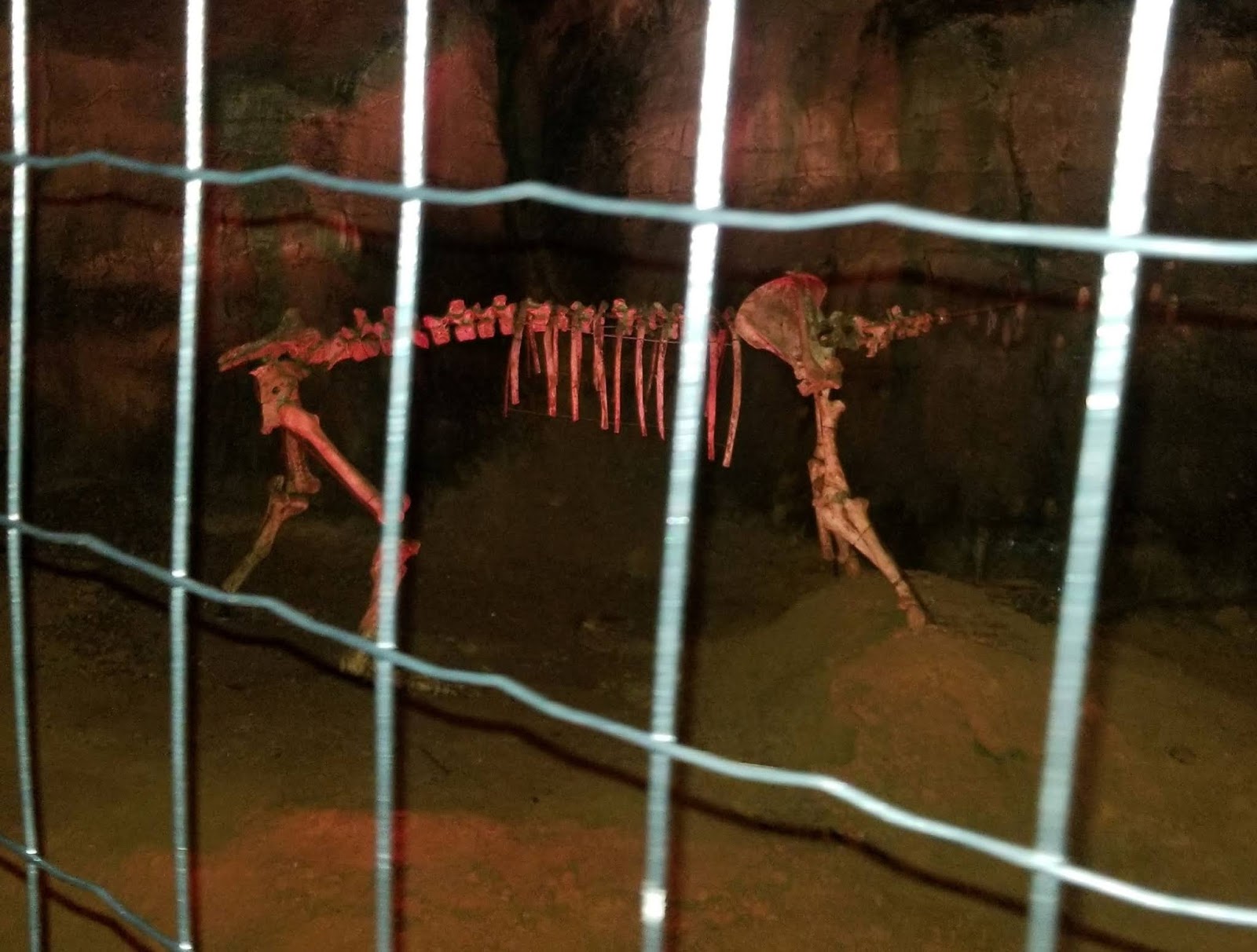
Cave bear fossils have been found. Fortunately, no live
specimens were to be seen on this trip, only some funny looking
recreations.
Our mooring site near Osselle. Easy in, easy out and adjacent
to the cycling path.
We started our cruising day on June 24 rather early for us. An intense heat wave that is expected to last for several days has moved into the area, and we wanted to do as much of our boating as possible while it was still relatively cool.

The remains of Montferrand-le-Château
 overlooking the Doubs.

The castle was first mentioned in records from 1230. It fell
into disuse as a fortification in the mid-1600's. Over the years
it was dismantled to build homes in the nearby village.
The Thoraise Tunnel. The upstream opening has a
"waterfall" feature that shuts off when its sensors detect
a boat moving through the tunnel.
There were interesting ceiling lights in the tunnel that blinked
on and off. The water feature at the tunnel opening was still
active at this point (but hard to see because of the brightness
outdoors)

The water reflected like glass during this part of the cruise on the
natural Doubs. The landscape is becoming more hilly.
Our destination for the day was the city of Besançon, the capitol of the administrative department of Doubs (and formerly the capitol of the Franche Comté region).

Approaching the city of Besançon, its famous 17th century
Citadel visible on the hilltop.
The city is located in a horseshoe bend in the river Doubs. Boaters have a choice when arriving at Besançon: take the tunnel carved through the rock under the Citadel, or take the "round the bend" route for a city view. "Take the city route" the guidebooks said, "it's very picturesque."  And so we did. It seemed like a good idea until we had to go through the St. Paul marina and lock. It was a tight fit moving through the marina, and the lock turned out to be manual, not automatic. I drew on my memories of operating the manual locks in Ireland in 2002 to deal with the issue, but the physical labor was not a welcome thing on the by-now very hot day.

Lon at the helm while cruising the loop; the Citadel
visible above.

Turning the wheel to open
 (or close) a lock gate door
Pat opening a sluice gate to let water out of the lock chamber.
We are planning to stay in Besançon for a few days. It has quite a few sites of interest, and we're also happy to be "plugged in" to electricity during this heat wave.