Thursday, June 15, 2023

Crowd Control

Just like "regular" life, our days have been a combination of accomplishing the basic and necessary tasks of everyday life (e.g., laundry, maintenance) and the "fun stuff" that helps us to become better acquainted with Paris. One of our big challenges has been, and will continue to be, how to best deal with the fact that there are currently hordes of tourists in the city. The post-Covid travel boom is on full display, and as we're not big fans of standing in long lines or getting caught up in throngs of spectators at those "must see" sights, we've made some decisions about what we will and will not attempt during our extended Parisian stay.

The sightseeing boats (this one on the Seine) are packed. We also see this from our
mooring in the Arsenal, as tour boats pass into and out of the St. Martin tunnel several times
a day, most of them loaded with customers. 

A visit to Versailles Palace is "out" for now. It's one of France's biggest attractions, and given the crowds we're seeing in Paris, we can only imagine how horrifically packed it must be at the moment. Maybe we'll get there in the fall before we head back to the U.S. We won't be revisiting the Louvre Museum either. Too popular, too crowded, too likely to drive us crazy. 

What we did do was start our wanderings last Saturday (June 10) at "Breakfast in America", where we know we can satisfy our cravings for a breakfast that isn't just pastry and coffee. The quality isn't quite up there with our St. Pete favorite "City's Bistro", but after seven weeks with no American-style breakfast, it was a real treat for us. The stroll afterward through the historic Marais district was a joy--Paris was just starting to stir in the late morning, and it's an area made for strolling rather than for visiting famous monuments or large museums. It's currently considered an artsy and "hip" area; in the 17th century it was a place of residence for the privileged royalty and upper class.

"Juliette has a gun" is, without doubt, a very strange
name for a shop that sells perfume.

The Library of the History of Paris, in what used to be a 16th 
century mansion. 

One quadrant of the Place des Vosges, originally Place Royale. It
is the oldest planned square in Paris and was built by Henry IV
from 1605-1612.  The square is surrounded by buildings all constructed
to the same design. Each quadrant of the square has a fountain like
the one pictured. The whole package was absolutely beautiful.
It was a great place for people to hang out.

We grabbed our bicycles and decided to see how truly 
bicycle-friendly Paris is these days. We didn't go too far--just north 
of the Place de la Bastille to the Saint Martin Canal. The bike lanes
were great, although between cars, pedestrians, bicycles, and 
scooters, we had a lot to keep track of in order to stay safe. For now,
for a more relaxed experience, we'll probably stick with
 the subway and walking!

Appropos of nothing, French public toilets
near the Canal St. Martin. Not great if you're shy.

In the afternoon we crossed the Sully Bridge into the Latin Quarter (so named because of the schools in the district, and the Latin language taught at many of them in the Middle Ages). It is one of the oldest districts in Paris, which was evident from the many meandering, narrow streets, reminiscent of the layout of medieval towns.

The Place de la Contrescarpe was a popular place for lunch.

The Jardin des Plantes botanical garden has existed for nearly
400 years. They say that they have 10,000 wild and cultivated
 specimens. Also on the grounds of the park are the National
 Museum of Natural History and a zoological garden.

The Latin Quarter is a popular place with tourists. It's
possible to find quiet streets, but Rue de la Huchette
isn't one of them.

Now here's a quiet street! And lovely buildings, too.

The Pantheon. Built during the later part of the 18th century
to be a church, it wasn't completed until after the French Revolution
had started, and the National Constituent Assembly voted to 
transform it into a mausoleum for the remains of distinguished
French citizens. Twice in the 19th century it served as a church, 
but after 1881 its exclusive use has been as a mausoleum. Among
those interred there are author Victor Hugo, Nobel laureate physicists
Marie and Pierre Curie, and most recently, performer Josephine Baker.

Luxembourg Palace and Gardens. The park adjacent to
the palace is a beloved gathering spot. Built in 1625, the palace 
was a royal residence before it became a prison during the French
Revolution. It is currently the seat of the French Senate. 

After walking nearly 10 miles on Saturday (and some of that was steps!), we decided to take a more relaxed pace on Sunday. In the morning we wandered through the large market set up just north of the Place de la Bastille (markets every Thursday and Sunday). 

The market was huge. Lots of produce stands (although most
things you could find in the grocery store for a similar price), as
well as meats, fish, and specialty products like honey (above).

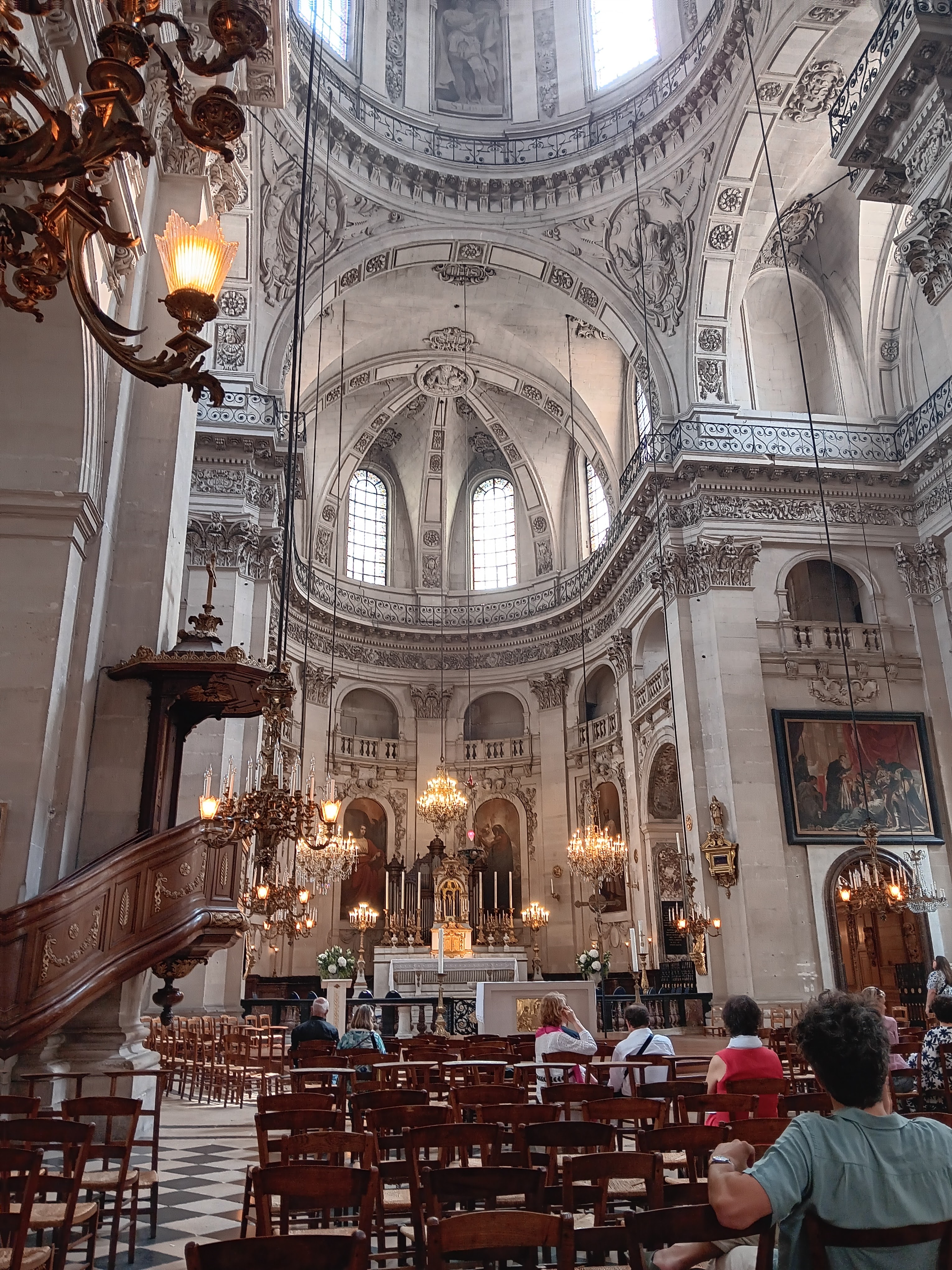
In the late afternoon we wandered back into the Marais neighborhood to the Church of Saint Paul-Saint Louis to attend a free organ-voice recital. It was just OK, and we took advantage of a disruption outdoors about 40 minutes into the concert to make our exit.

The interior of the Church of Saint Paul-Saint Louis.

The outside "disruption" was an environmental demonstration,
complete with a group singing songs that could be heard inside
the church. The crowd outside was appreciative, but not
the car drivers or bus riders, as the street was effectively blocked.

A 10-minute metro ride on Monday afternoon (No. 1 line direct from the Bastille station--convenient!) took us nearly to the entry gate to the Chateau de Vincennes. This fortified royal residence began as a hunting lodge in the 12th century. Charles V (1364-1380) completed much of the work on the large keep, and then surrounded it and the manor (which existed in the 13th and 14th centuries but was destroyed starting in the 17th C) with a protective wall. He died before the chapel--if something that large can be called a chapel--was completed. The chateau served as a prison from the 15th through the 19th centuries (one of its "guests" was the Marquis de Sade) and was a place of refuge for French monarchs during the 16th and 17th centuries, but was abandoned as a royal residence when Louis XIV decided to settle in Versailles in the late 1600's. From that point it became a major arsenal.

The Germans occupied the chateau in WWII. The complex sustained major damage in 1944, when the retreating Germans set off explosives in three areas of munitions storage. 

The chatelet in front, and the tall keep, where Charles V had a residence, in the background. At 50 meters high, it is the tallest medieval keep in France. 

View from the observation level of the chatelet toward Sainte-Chapelle, the Holy Chapel.

The classical pavilions (buildings to the right and left) are 17th century additions
ordered built by Louis XIV.

The story of our time in France, on this day as well as many
others. 70 steps to get up to the balcony level in the chapel;
I have no idea how many other steps we conquered in the numerous
circular staircases we climbed that day. In case there's any
doubt, those are Lon's lovely legs in the background.

Lon on the 1st level entry to the keep. When the
 keep was built, this was the only way in.

The ceiling in Sainte-Chapelle. 

"Tree of Life" art installation in the Holy Chapel.
The photo doesn't do it justice. It had small lights
throughout, and over 100,000 hand-sewn leaves.

View of the chatelet, which formed the main entrance to the
keep. We were permitted to climb to the terrace (just to the
left of the small tower) for a great view over the chateau grounds.

All-in-all, it was a great place to visit. The only crowds we encountered were several groups of schoolchildren, and their itineraries did not impede anyone who was doing the "regular" visit. If there were a magic formula for touristic visits, this was it: easy to get to, interesting historical site, and no crowds. Too bad we couldn't quite duplicate the "total package" the next day.

Sunday, June 11, 2023

Transition

Our last overnight stop on the Marne prior to reaching Paris was the town of Lagny-sur-Marne, a mere three-hour cruise from Meaux. We are happy to report that we had no Gilligan-style mishaps on the way.

We are definitely away from vineyards, but as close as we are to Paris, it still feels very rural.

A small (600 meter) tunnel enroute, buried under greenery.

Lagny had a great halte nautique for our overnight stop. Any chance to plug into
electricity is welcome.

During the Middle Ages, Lagny was a popular place in Northern France for tournaments. It had a fortified castle . . . of which only remnants remain (and not in their original location). It had an old market hall . . . of which the arches remain. It had the Church of Saint-Fursy, sold during the Revolution . . . and of which only the western facade remains. It had an abbey and its church . . . of which the church still remains (although not all construction is still from the Middle Ages) and an abbey building from the 18th century (nowadays used as the Town Hall). Still, for all that was missing, the town had a very pleasant "feel" and we enjoyed the stop.

The western facade of Church of Saint-Fursy has been
incorporated into a more modern building behind it.

Lon passing under the arch of the former fortified entry
 leading to the old abbey courtyard area.

The rear garden of the old abbey church, the Church of Notre-Dame des Ardents. The choir of the church is probably the oldest part (13 C) of the building. Every church in France seems to have
at least one statue of Joan of Arc, and this church had two: one inside, and one outside.

Joan of Arc was in Lagny twice during her short life. During her visit in 1430, it is claimed that her prayers brought back to life an unbaptized, newborn infant who had been dead for three days. The child yawned three times, and started to regain color, but apparently lived only long enough to be baptized. For some reason, this was not one of the miracles listed in support of the process leading to the declaration of her sainthood in 1920.

A plaque in the church which contains an account of
the miracle, as conveyed to the judges presiding over Joan's
trial in Rouen after her arrest.

 We made the transition from suburban Lagny to urban Paris on Tuesday, June 6.

Starting to see more hints of the urban area to come.

Our last tunnel.

Sharing the last lock on the Marne with a
commercial vessel.

Making the Marne quays "beautiful"?

A Chinese-themed hotel and restaurant marks the confluence of the Marne
and the Seine. We were now about 4 kilometers upstream from our entrance into Port de Arsenal.

First views of the Seine. This is not the side of Paris in which the Eiffel
Tower is found. We will have to be satisfied with modern buildings
and an industrial "vibe" for now.

These may not have been the beautiful, historic buildings we love
to see in central Paris, but they were interesting, nonetheless.

Because we arrived in Paris a few days earlier than we had originally arranged with the Port de Arsenal, we had to take a temporary mooring for the first two days until our long-term slip was vacated. This temporary mooring had us rafted to another barge very close to the lock that separates the Seine from the Port. We used the two days to do tasks such as cleaning and grocery shopping, as well as simply to acclimate ourselves to a lifestyle where we weren't either cruising--or getting ready to cruise.

This photo was taken from a pedestrian walkway that crosses the basin
about halfway down the length of the basin. The entry lock is
 to the upper right-hand side of the photo, and CARIB III is the small
 blue and white object on the left side of the water, about mid-photo.

We had "entertainment" on Wednesday morning, when the local
rescue service ran some practice drills in the port.
 
A mid-week, mid-day stroll along the Seine is sedate
and uncrowded.

France is getting ready to host the 2023 World Para Athletics
Championships in July. We saw this in front of the Hotel de Ville
(town hall), with an apparent tie-in to the Olympics (to be
held in Paris in 2024).

On Thursday, June 8, we were able to relocate to our "permanent" mooring. We are nearly all the way down the basin from the entry lock, essentially adjacent to the tunnel opening that leads to the Saint Martin Canal. All we have to do is pop up the stairs in front of the boat and we're in the Place de la Bastille.

CARIB is visible from a vantage point in the Metro station
that is located on the bridge over the tunnel. Very
convenient, and surprisingly, not particularly noisy. Not
particularly private for us either, I suppose.

Finally settled in one spot until June 27, on Friday we headed out to Port Cergy (where we had moored the boat last winter) to retrieve some official boat certification documents that had been mailed from the Netherlands. We always love the comparison between "boat time" and "land time." In this case, one hour via train and walking to get between Port Cergy and the Arsenal vs. five weeks by boat to travel by canal and river on the route we took. Of course, there were faster routes to cruise between the two locations, but we were really happy with the route we took and the experiences we had.

While in Cergy we had lunch with our Australian friends
Rose and Steve, who are preparing for their own
cruising season.

On our return to the boat we stopped at the area of Paris known as La Defense. This is Europe's largest planned business district. It was named after a statue--La Defense de Paris--from 1883 that commemorated soldiers who had defended Paris in the Franco-Prussian War more than a decade earlier. Construction on the buildings started in the 1950's, and continued on-and-off into the 1990's. Being there was like stepping into a different world.

The Grande Arche de la Defense. It was designed to be a late-20th
century version of the Arc de Triomphe, meant to celebrate 
humanitarian ideals rather than be the tribute to military victories
 that prompted construction of the Arc de Triomphe.

From the perspective of the Grand Arch, looking down the esplanade, one can just barely see
the Arc de Triomphe in the distance. La Defense lies at the end of a 10-kilometer long "historical
axis" of Paris, hence the straight line to the Arc de Triomphe.

Inside the shopping mall are the balconies for the very
modern Hilton Hotel.

It was a bit of a relief to get back to historic Paris, where the scale of the buildings and the neighborhoods have a more "human" feel.

Our Friday night walk around the port. Parisiens love
to picnic next to waterways in the evening, and the Arsenal
became quite a hotspot of conviviality. Mostly, we
just sat on our back deck and soaked in the atmosphere.

We have lists of things we'd like to do while we're here, but we don't want to run ourselves ragged, so we'll see where things end up.

Wednesday, June 7, 2023

American Remembrances in France

By the time we got to the town of Chateau Thierry on Tuesday, May 30, we had mostly left Champagne vineyards and champagne tourism behind us. Chateau Thierry is about 60 miles to the northeast of Paris. A town has existed on the site since at least the late Roman era, but most of the older structures in the town were destroyed during various wars throughout the centuries. The more recent and notable battles were those that occurred during the Napoleonic Wars between France and Prussia and the Second Battle of the Marne in 1918. 

View over Chateau Thierry from the remains of the castle of Chateau Thierry. A castle was first
built on the hilltop site back in the early 700's. Not much remains today aside from some portions
of the 13th century ramparts. 

We took the shortcut up to the castle, which involved--of
course--stairs!

Our reward for all the climbing was a great view
of the castle remains.
A view in the opposite direction, with the local church in the
near distance, and on a hill in the far distance, the 
white Chateau-Thierry Monument.
                               
Lon starting to make his way up the steps.

At the top of the city steps was the entry to one of the castle
towers, which contained even more steps.

Chateau Thierry also proudly proclaims itself as the birthplace of the French fabulist Jean de la Fontaine, who was also one of the most widely read French poets of the 17th century.

The birthplace of La Fontaine contains a well-regarded museum
that, unfortunately for us, was closed for renovations (until 2025).

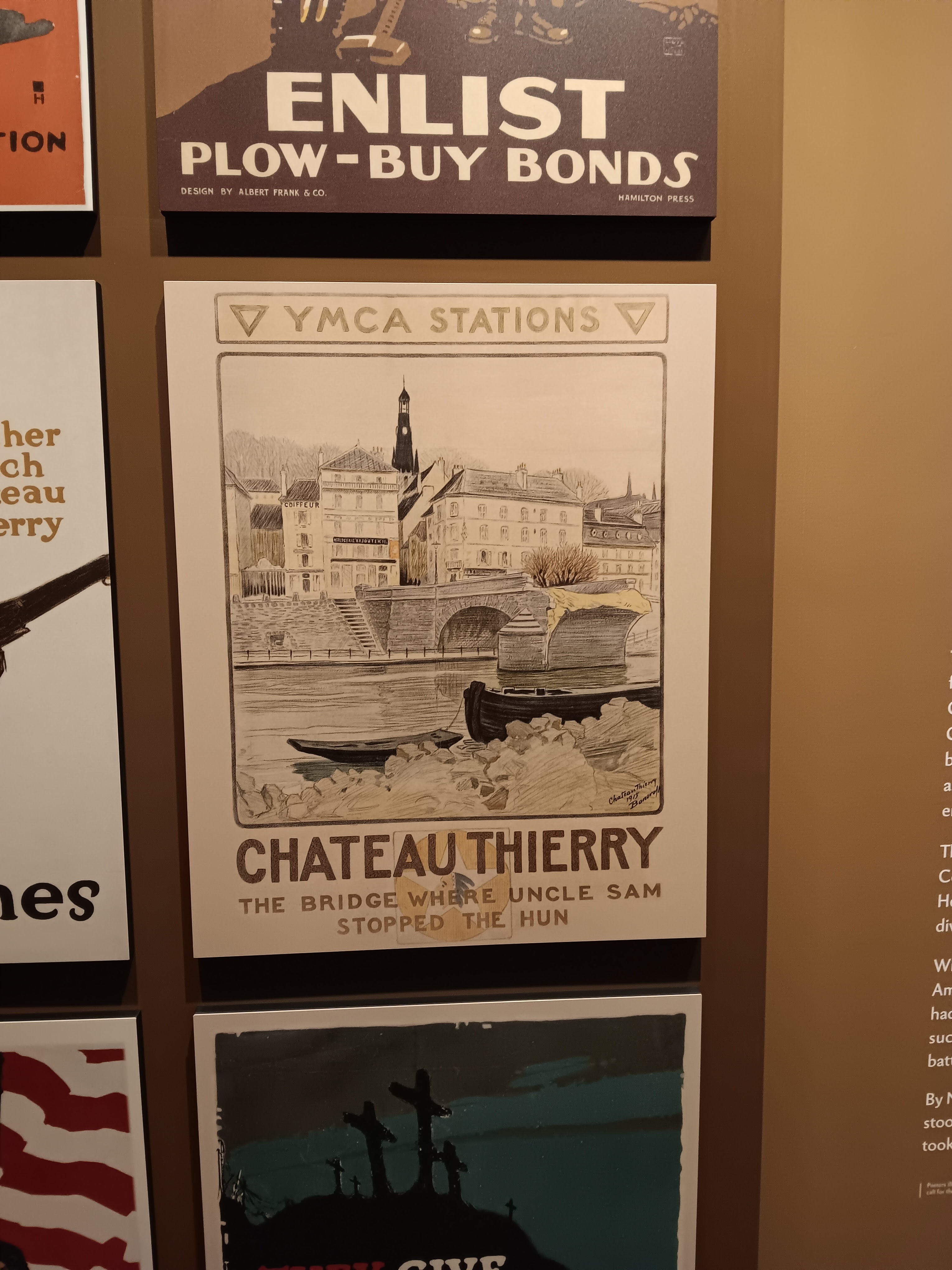
More important to us than this ancient history was the more modern history related to the First World War. The Battle of Chateau Thierry was fought in July 1918 and was one of the first actions of the American Expeditionary Forces under General John Pershing. It, along with the nearby Battle of Belleau Wood, was part of the Second Battle of the Marne, and a response to the last attempt by the German army to break through to Paris. The combined French and American forces were able to drive back the German offensive. The gratitude and recognition of the French for the American assistance is visible even today.

Banners flying from the mayor's office building were
a mix of American and French flags.

The Chateau-Thierry Monument, built by the American Battle Monuments Commission
on a hilltop (Hill 204) on the outskirts of town, "commemorates the sacrifices and 
achievements of American and French fighting men before and during the Aisne-Marne and
Aisne-Oise offensives."  

The monument contained a small, but very
nice, museum.

Figures depicting the unity of the United States and France. 

We left Chateau Thierry on Thursday, June 1, and our subsequent two stops were near quiet, country villages.

No cathedral in Iles les Meldeuses, just a small 12th century
Romanesque church.

Dawn on a slightly foggy Marne River. Given that sunrise
is about 5:50 a.m., this is proof positive that Lon gets
up waaay too early.

Cruising curiosities: a now-abandoned diving platform
along the Marne.

On Saturday, June 3, we pulled into another relatively large town, Meaux (pronounced "Mo"). Meaux was delightful on several levels. From a boating perspective, we loved that they had a halte nautique with large pontoons (docks) that could accommodate a boat our size, and that had electricity and water (temporarily free!). 

The view from our mooring in Meaux.

A little closer to the boat, we got to enjoy this family of 
swans as a reminder of new life in the spring season.

From a tourism perspective we were pleased that, on Saturday night, we were able to attend a free concert in the cathedral--with vocal and instrumental ensembles--of music of Johann Michael Haydn, and Sunday was "free entry to the local museums" day because it was the first Sunday of the month. And of course, we had to partake of the usual "looking around" at the local significant sites.

Meaux had a lovely gothic cathedral, with much of the building construction taking place from the 12th to the 16th centuries.

Most of the holy figures surrounding the south porch
entrance to the Cathedrale St Etienne "lost their heads"
 in the 1500's during the Wars of Religion.

The lovely Bossuet Garden (named after the most famous of 
the bishops of Meaux) behind the Episcopal Palace.

We loved the staircase of this building, and the connection to the 
cathedral by a timbered walkway.

The Episcopal Palace, and behind it the cathedral.

The performance of "Missa Sancti Aloysii" in the magnificent interior of the cathedral.

We enjoyed an Italian dinner in the plaza by the west 
 facade of the cathedral prior to the concert.

The boundary to the rear of the Bossuet Gardens was a remnant of
a Gallo-Roman fortification wall, with towers added in the 15th C. 

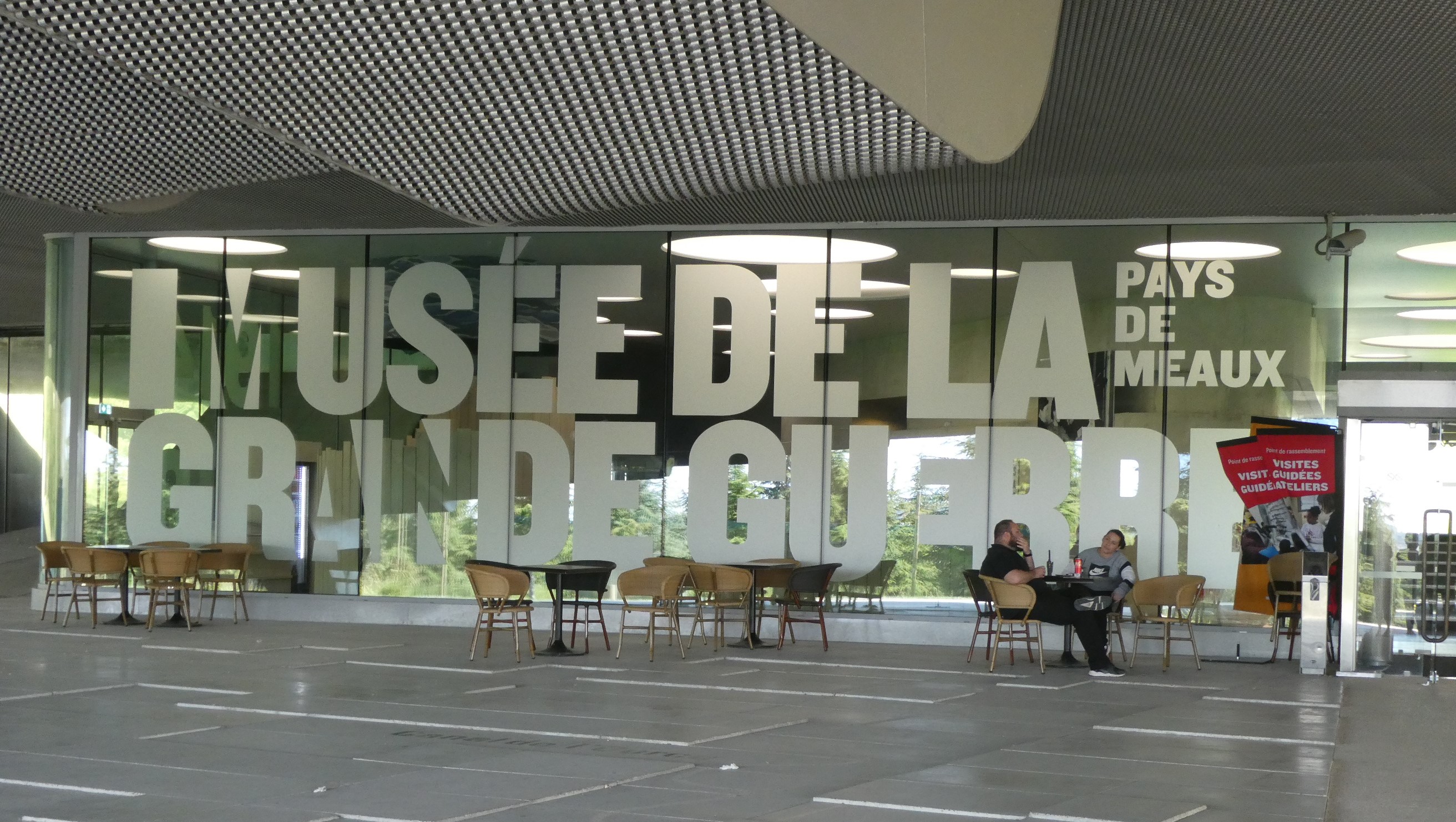
Sorry to say, on Sunday we didn't take advantage of our free museum entries to visit the "cheese museum" dedicated to the story of the special Brie de Meaux cheese, but we did go to the "Musee de la Grande Guerre". The museum opened on Armistice Day in 2011 and is Europe's largest museum dedicated entirely to the First World War. 

The museum has a modern architectural design. And it was large. Normally, we "run out of steam"
pretty quickly when going through museums, but this one was really well done and provided
information in multiple ways that made it accessible and not overwhelming.

A WWI communication truck--complete with
the pigeons that carried the messages.


Immediately adjacent to the museum was this statue
known as "The American Monument." It's currently under
repair due to damage from a lightning strike in 2021.
 It was designed by an American sculptor and given as a
gift by the U.S. to France in honor of the fallen
soldiers of the First Battle of the Marne.

We are very nearly in Paris at this point. Meaux is only about 30 miles from Paris, and is already in the outermost of the Paris transportation zones. Another two days of cruising will complete the Marne River portion of our cruising itinerary. We're looking forward to our 3 weeks in the big city.